Showing posts with label Arizona Fall League. Show all posts

Thursday, November 3, 2011

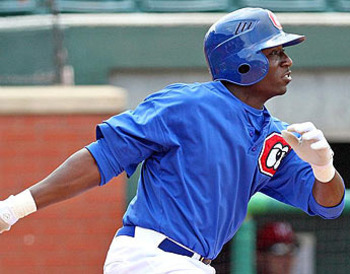
Arizona Fall League Scouting Report: Junior Lake


Junior Lake (Chicago Cubs Shortstop)

Age: 21
Height: 6’3”
Weight: 215lbs
Bats: Right
Signed out of the Dominican Republic in 2007

Cubs fans are looking for reasons to be optimistic about the organization’s near future.  While it’s nice to have a competent front office in place, there’s not a lot of talent down on the farm upon which to be stoked.  Don’t get me wrong, the system has a handful of future contributors at the major league level, just no true stars.  This includes Junior Lake, who has an interesting set of tools but has yet to overly impress anyone with his performance.  Even though his value ceiling isn’t notably high, Lake’s development will be one of minor league baseball’s most interesting to keep tabs on simply because he may be subject to three (yes, three) positional changes down the line. 

Body:

Lake is going to grow out of shortstop.  He’s listed in the AFL guide as 6’3”, 215lbs.  That’s an inch taller and fifteen pounds heavier than he was at the beginning of the season.  He’s only 21 and looks like he’s going to get bigger.  Not a good, upper body development, power improving bigger, but a thigh and ass widening bigger.  That kind of bigger usually means slower, and as an already fringe average runner (I had times from home to first in the 4.34 to 4.38 seconds range) that sort of sluggishness doesn’t play at short. 

Offense:

Lake has the physical tools to be an offensive asset.  He has very good eye-hand coordination and fine bat speed.  His swing path has some leverage to generate natural loft.  When he makes contact, it’s usually very hard.  His raw strength and the torque generated by rotation in his hips give him above average raw power.  His plate coverage could use some work. Lake starts out in an open stance and doesn’t come totally closed when he strides, leaving him vulnerable on the outer half.  What really limits his offensive output is his approach which, to put it nicely, is “aggressive”.  It borders on reckless with lots of early count hacks.  He had 19 walks in 478 plate appearances in 2011.  That’s deplorable.  He doesn’t allow himself to get into favorable counts where he can unleash his physical gifts into offensive production.

That recklessness carries over to the bases where Lake tries to swipe bags every chance he gets despite his fringy speed.  He likes to run on first pitches and is unopposed to attempting to steal third base as well.  The weird thing about Lake’s irresponsible and predictable base running is that it worked in 2011.  He stole 38 bases and was only caught six times. 

Defense:

I’ve already discussed the growing issues Lake has with his range which is fast becoming (if it isn’t already) insufficient for shortstop.  He does have good hands and an arm that grades out as at last a 70 on 20-80 scale.  He’ll likely move to third base in the near future, where the lack of range won’t be as big of a deal.  If he outgrows that position, he’ll move to right field where the arm can still be an asset.  He’d probably play a fine right field, but you have to wonder if he’ll hit enough to be a regular in the outfield.  Based on what I saw in Arizona, I doubt it.

Conclusions:

Junior Lake’s career could travel down several avenues.  He could stick at third base where replacement level is so low that a .260/.330/.480 line would stick.  He could outgrow the infield altogether and move to the outfield where he’d just be an extra guy.  Perhaps most intriguingly, the Cubs could move Lake and his howitzer to the mound, teach him to throw a slider and have a power bullpen arm for a few years.  Until Lake’s swing happy approach falls through at the upper levels, the Cubs likely won’t cross that seldom traveled bridge.




Thursday, October 27, 2011

Arizona Fall League Scouting Report: Dan Burawa


Dan Burawa (Yankees RHP)

Age: 22 (turns 23 in December)

Height: 6’3”

Weight: 190lbs

12th round pick in 2010 out of St. John’s University

The kind of velocity Burawa brought to the table as an amateur is that of a player who typically goes much earlier than the twelfth round, but he came from an under-scouted region and fell into the lap of his hometown Yankees later than he probably should have. It’s also possible Burawa fell due to makeup issues. He was suspended early in his final collegiate season for reasons I cannot uncover. We all do stupid things in college (And in adulthood. Right, Catasauqua Police Department?) so I wouldn’t expect that to be an issue moving forward. Burawa signed for earlier round money ($300,000) and the Yankees sent Burawa to the AFL this year in hopes that he can polish up so they can start to get a return on that investment. I had no idea what to expect from Burawa as he trotted out of the Phoenix Muni bullpen last week and came away pleasantly surprised.

Body:

Burawa is becoming a bit of a porker. The weight listed above (which is the weight listed in the official AFL program) is likely a gross underestimate of Burawa’s gustatorial accomplishments. I describe him in my notes as, “Barrel Gutted”. He’s likely to widen as he ages. Does it matter? Not really. Burawa has always profiled as a reliever so it’s not as if he needs to maintain a high level of cardiovascular fitness in order to pitch multiple innings.

Stuff:

The fastball is plus, sitting in the 93-95mph range when I saw him. It lacked horizontal movement but had nice natural sink, a downward action that occurred late in the pitch’s path toward the plate. He coupled that with an average slider that is quite short but comes in hard, 84-87mph. As an amateur, Burawa sported a curve and changeup. It’s likely that at least one of those has been scrapped altogether while the other exits purely as a show-me pitch for lefties. Neither of those pitches was good when he threw them and I saw neither of them last week.

Mechanics:

Burawa’s lower half is stiff and inflexible. He does not use it efficiently. As we move upward, the rotation in his hips generates considerable torque and adds to his velocity. The arm action is long and low, putting abnormal stress on the shoulder but it’s also the cause of the sink on his heater. There’s also noise above the shoulders, which is likely the cause of his poor command. These are sins one can live with since we’re just talking about a reliever here.

Stats:

IP: 84 (not including AFL innings)
Strikeout to Walk Ratio: 2.75:1
Strikeouts per Nine Innings: 7.1
ERA- 3.64
FIP- 2.46


Conclusions:

Dan Burawa is your typical one and a half pitch, nausea-inducing arm action pitcher who will make a nice middle reliever for a few years before either blowing out his shoulder or suffering from the sudden, precipitous decline that befalls so many relievers. 

Monday, October 24, 2011

Arizona Fall League 2011 Trip Primer

I'm back from my trip to the 2011 Arizona Fall League.  It was anything but the restful week I had anticipated it to be.  Of course, I loved it.  I can't say enough about how inherently cool the league is.  Below are the players I took notes on.  Expect scouting reports on these players either here, on Through The Fence Baseball (a website I was just hired by) or both. These are in no particular order.

Nate Baker
Chris Carpenter
Gerrit Cole
Terry Doyle
Marcus Hatley
Nevin Griffith
Brett Jacobson
Steve Johnson
Casey Lambert
Jake Petricka
Bruce Pugh
Dakota Watts
Michael Blanke
Brian Dozier
Junior Lake
DJ LeMahieu
Joe Mahoney
Tyler Saladino
Xavier Avery
Robbie Grossman
Aaron Hicks
Brandon Short
Josh Vitters
Anthony Bass
Robert Carson
Danny Hultzen
David Kopp
Tyler Lyons
Jason Hagerty
Matt Adams
Nick Franklin
Scooter Gennett
Jedd Gyorko
Ryam Jackson
Chih-Hsien Chang
Kentrail Davis
Jaff Decker
Logan Schafer
Oscar Taveras
Brad Boxberger
Dan Burawa
Anthony Capra
Andy Carnigan
Aaron Loup
Evan Crawford
Donnie Joseph
TJ Macfarland
David Phelps
Tyson Ross
Chase Whitley
Yasmani Grandal
Ryan Ortiz
Adeiny Hechevarria
Corban Joseph
Ronnier Mustelier
Michael Choice
Anthony Gose
Grant Green
Steve Ames
Charlie Brewer
Casey Crosby
Andy Oliver
Cole St. Clair
Josh Wall
Jason Castro
Nolan Arenado
Dixon Machado
Ben Paulsen
Ryan Wheeler
Jay Austin
Adam Eaton
Tim Wheeler
Dave Carpenter
Tyler Cloyd
Jacob Diekman
Austin Fleet
Stephen Harrold
Pat Lehman
Daryl Maday
Matt Purke
Sammy Solis
Andrew Taylor
Colby Shreve
Dan Tillman
Hank Conger
Derek Norris
Brandon Crawford
Will Middlebrooks
Cody Overbeck
Joe Panik
Jean Segura
Gary Brown
Tyson Gillies
Bryce Harper
Mike Trout
Alex Hassan
Sean Gilmartin
Adam Libatore
Brendan Lafferty
Ryan Kelly
Yohan Yam
Kevin Mattison
Tim Beckham
Wil Myers
Matt Dominguez
Chistian Bethancourt
Leury Garcia

That's a lot and I probably missed some.  As always my primary goal is to please my readers.  So, if there's an Arizona Fall League prospect whose report you'd like me to prioritize feel free to post in the comment section or email me at elongenhagen@gmail.com.  For now, I'm going to get some much needed rest and will start writing guys up tomorrow.

Tuesday, January 11, 2011

Arizona Fall League Scouting Report: Trayvon Robinson

Trayvon Robinson OF (Los Angeles Dodgers)


Age: 23

Bats: Switch

Height: 5’10”

Weight: 175lbs

From: Crenshaw High School (10th round of 2005 draft)

Sometimes teams will draft high schoolers with a bevy of physical tools but little in the way of baseball skill. These are your typical boom or bust type picks, and lots of times these guys take more time to reach the majors than your polished college players (think about how polished Rick Porcello was coming out of high school vs how raw Phillipe Aumont still is). Trayvon Robinson is one of those raw, physically gifted athletes that needed time. Actually, Robinson didn’t even start switch hitting until after he was drafted. Grab a bat and swing it from your weak side. Try not to look like an idiot. Think about how goofy you look and now imagine trying to hit pro pitching like that.

Robinson spent 2006-2008 mired in prospect limbo waiting to yield results. In 2009 he finally broke out hitting .306 with a .375 OBP and .500 Slg% at Hi A before moving to AA. He hit more HRs that year than he did in his previous four years combined. He also stole 43 bases. The Dodgers already have

Offense:

Robsinson hits well from both sides of the plate but you can tell in BP that he has more power from the right side. His swing mechanics are fine. What he sometimes has a problem with are his feet and what he does pre-swing. In the batting practice video below you can see he is well out in front of the first few pitches before he starts to adjust. His front foot is hanging in the air far too long and throwing off the timing of his swing. That’s too many moving parts to control at once which makes it difficult to have a fundamentally sound swing. In the second video, you can see his front foot is down much earlier. This doesn’t hinder his hip rotation, which is where a lot of swing power comes from. The Dodgers have worked with his pre-swing motions.

Robinson’s walk rate has also vastly improved. Instead of 3 walks every 30 plate appearances, Robinson is walking 3 times every 20 Pas. That may not seem like much but over the course of a season it is the difference between a .350OBP and a .400 OBP, which he posted in 2010. He was a little too patient when I saw him in Arizona, striking out looking 3 times in the two games I saw him play.

Combine those on base skills with Robinson’s elite speed (40 steals each of the last 3 years) and you’ve got a potential leadoff guy with some power.


Defense:

Robinson has the physical tools to play in CF; great speed and an average arm. However, he doesn’t always take great routes to ball and the Dodgers already have a CF in place. He’d be above average in LF and I’d expect him to play their regularly for the Dodgers by late July.


Thursday, December 30, 2010

Arizona Fall League Scouting Report: Eric Hosmer

Eric Hosmer 1B (Kansas City Royals)


Age: 21

Bats: Left

Height: 6’4”

Weight: 215lbs

From: American Heritage High School, Plantation, Florida (#3 Overall pick in 2008)

Hosmer’s first pro season (2009) was extremely disappointing as he posted a paltry .707 OPS (major league average is .730) between low and high A ball. His struggles can be attributed to an astigmatism, which he developed during the offseason prior to the 2008 campaign and was diagnosed with prior to the season. Combined with his poor eye sight which was eventually corrected by Lasik eye surgery, Hosmer fractured a knuckle on his right hand which impeded his ability to grip the bat. When you can’t see the ball you’re supposed to hit or grip the bat you’re supposed to hit it with, you are going to struggle. The results he yielded in 2009 caused him to fall to #5 in Baseball America’s Prospect Handbook, down from #2 the previous year.

The following season, Hosmer had a fantastic .977 OPS while hitting 20 HRs, 7 of those HRs coming in an infamously difficult home park at Single A Wilmington. He reached AA ball at age 20 and completely reestablished his astronomical value as one of baseball’s better prospects. He’s turned everything around and has all star potential.

Offense:

Hosmer has a smooth left handed swing. He combines fine bat speed with good balance and generates plus raw power. He takes the ball the other way comfortably. More impressive for me are his low strikeout totals. Hosmer struck out 66 times in 520 at-bats in 2010 and walked 59 times. That’s a rather impressive ratio for someone to boast for their 20 year old season.

The one problem Hosmer has is a tendency to get his front foot down late (Ryan Howard has the same problem from time to time) which throws his swing off and causes him to get pull happy.

Hosmer is a below average runner and won’t help on the bases.


Defense:

Hosmer has an above average throwing arm that would play in the outfield which would be beneficial to the Royals because of the glut of 1B/DH types they have coming up through the minors, but his slow feet would limit his range in an outfield corner and he’d end up as a liability. He has soft hands and is enough of an athlete to be above average at first base.


As far as ceilings go, Hosmer may be the best 1B prospect left in the minors (though Brandon Belt is much closer to the majors) and is one of the crown jewels of the Royals’ stellar farm system.


Above: A couple looks at the swing
Below: A really great at-bat

Monday, December 20, 2010

Arizona Fall League Scouting Report: Jeremy Jeffress


Jeremy Jeffress (Kansas City Royals)


Age: 23

Height: 6’1”

Weight: 185LBS

From: South Boston, VA (1st rounder in 2006 straight from High School)

Part of the recent Zack Greinke trade, Jeffress had one of the more electric arms I got a chance to see at the Arizona Fall League. We’ll get into that in a minute, but upfront there’s one very important piece of information you should know about Jeffress. He’s one toke away from a lifetime ban from baseball. Jeffress has already been suspended twice for violating baseball’s substance abuse policy and a third time means he’ll get the boot. I don’t have a problem with pot use as long as it doesn’t alter work habits or on field performance, and in Jeffress’ case it just might.

Like a lot of the pitchers in Arizona, Jeffress had primarily been a starter during his pro career (unitl this past season) but projects as a bullpen arm. The Royals will almost certainly insert him in the bullpen immediately, in part to free him from the more strict nature of the minor league drug testing policies. If the Royals decide to trade Joakim Soria, Jeffress will be ticketed for high leverage inning (the few that exist in KC) work right off the bat.

Stuff:

Jeffress’ fastball is devastating. He sat at 95-97mph and touched 99 once when I saw him in person in mid October, and then hit 101mph on TV during the Rising Stars game. It’s very straight, almost no tail, but the raw velocity behind it more than compensates.

Sure, the fastball is good but the secondary stuff is lacking. I had read that his curveball was flashy and inconsistent but I didn’t even see a glimpse of a swing and miss breaking ball in any of his outings in Zona. When he did throw it, it was blunt and hittable in the upper 70s. His changeup sits in the mid to high 80s. He can throw it for strikes, but his arm speed is noticeably slower than it is when he throws the heater. The dominant fastball and lack of viable secondary offerings already points to the bullpen.

Mechanics:

Throws from a three quarters arm angle and has fairly easy arm action for someone who throws so hard. He does not repeat his delivery well. You can clearly see this in the video below when he drops his arm angle significantly on his final warm up offering. This inability to repeat the same throwing motion leads to control problems and is likely the cause of his curveball’s inconsistency as well as his problems with command.

Stats:

He strikes out a ton of batters, and has had problems with walks (sounds like a reliever to me). His walk totals dropped significantly last season (from 8 per 9 innings in 2009 to 3 per 9 innings in 2010) but the sample of innings from 2010 is too small (due to the suspension) to say his control issues are solved.

Thursday, December 9, 2010

Arizona Fall League Scouting Report: Michael Taylor


Michael Taylor (Oakland Athletics)


Age: 24 (25 on December 19th)

Height: 6’6”

Weight: 250lbs

From: Stanford (5th round of 2007 draft)

After Taylor was part of the Roy Halladay trade (and immediately spun to Oakland for Brett Wallace) he went on and had what can only be described as a as a disappointing year at Triple-A. He hit a modest .272 and slugging an atrocious .392 Pacific Coast League which tends to be rather hitter friendly. Taylor was my favorite IronPig to watch (because he had actual, big league talent) in his tenure there and I saw, daily, the talent he possesses. I had a hard time believing it all just disappeared. My brief trip to the AFL allowed me to catch a glimpse of those tools all over again.

Offense:

Taylor’s never fully tapped into his physical potential. He’s a monster at 6’6”, 250 and you’d expect him to have a ton of raw power. He probably does, but his swing doesn’t allow it. Stanford coaches typically alter incoming high-schooler swings and teach habits that a lot of pro scouts claim need to be untaught, but I’ve read Taylor committed to Stanford on the condition that they didn’t alter his swing. Maybe the Cardinal coaches aren’t to blame (by the way, if Stanford is supposed to be this school for brilliant, hard working minds, shouldn’t they pluralize “Cardinal”? ). So the power is good, but not as good as you’d think it’d be by looking at him.

I’ve seen Taylor spray balls all over the field with authority and hitting .270, while disappointing for him, isn’t terrible. He was making solid contact at the AFL when I saw him.

Taylor has above average speed and good instincts on the basepaths.


Defense:


Taylor has a fine arm and good range. I fondly remember watching him throw out guys trying for a double from the left field corner of Coca Cola Park. He could play either corner at an above average clip.

Overall, Taylor had a bad year, none of which I got to see in person. It’d be stupid to write him off after one bad year just as it would be stupid to crown a player as elite after one good one (see Bautista, Jose). That said, next season is a crossroads in Taylor’s career. He either becomes a solid regular with the potential to have an All Star season or two, or an upscale reserve outfielder in his mid twenties. I’m unabashedly rooting for him. Let’s check some video!


Tuesday, November 30, 2010

Arizona Fall League Scouting Report: Dustin Ackley

Dustin Ackley (Seattle Mariners)

Age: 22

Height: 6’1”

Weight: 185lbs

From: North Carolina (2nd overall pick in 2009 draft)

Ackley (selected immediately following Stephen Strasburg in the 2009 draft, was expected to fly to the major leagues. He was a very polished hitter coming out of college and everyone figured he’d enjoy a cup of coffee in the big leagues at some point late in the year, especially if the Mariners were in position to contend. Hell, he started his career all the way up at AA. This is all pretty impressive considering that Ackley wasn’t even drafted out of high school.


Instead of tearing through the minors, Ackley had a really rough first couple months. It took time for him to adjust to subtle environmental changes, like using wooden bats. Combined with that, Ackley was learning a new position, second base, instead of playing first base or in the outfield.


Later in the year he started to heat up and by the time the Arizona Fall League came around, he was downright on fire. He was named MVP of the AFL. I figure he’ll be in the majors at some point next season.


Offense:

Ackley great excellent pitch recognition and handles the strike zone well, walking almost as much as he strikes out. He swing is flawless, he has good hand-eye coordination, takes a short path to the hitting zone, and has fine bat speed. When I saw him, he was hitting the ball HARD, and all over the field. Stuff I read on Ackley as he struggled this year seemed to indicate that he was slapping at the ball Luis Castillo style. That’s not what I saw at all.

As far as hitting for power goes, only time will tell if Ackley will be a serious threat. Hitting for power and getting carry on the ball is about strength and being able to get backspin on it, and Ackley's showed it during batting practice sessions. Now it's just about carrying that forward into games a little more, although he is probably never going to be more than a teens homer hitter.

He had trouble this year against lefties, but it was only a 150 atbat sample size so don’t treat it as gospel.

I haven’t even gotten to Ackley’s most impressive tool, his speed. I timed him at 4.07 from home to first base, a 70 runner on the 20-to-80 scouting scale in terms of raw speed. That is way fast. As he learns to steal bases, he’ll become one of the most dangerous leadoff hitters in the game, because he’ll be on base a ton to use that speed.


Defense

Still a work in progress at second base, Ackley obviously has the tools to one day have fabulous range but his footwork is currently poor. His arm is below average, so he’s not an ideal fit in center field. He played a lot of first base in college due to an injury to his throwing arm, but a leadoff hitting, 30 steal threat is atypical for 1b. I have questions about his hands, as well. I'd like to tell you he'll get nice and cozy at 2B but he really looks stiff right now.  I think he eventually ends up in LF, and while that eats a sizable chunk out of his value a LF that hits .325 with a .410 OBP is still a good player.

Future MLB Comparison: None, this guy is a different breed.


A look at the swing

Saturday, November 20, 2010

Arizona Fall League Scouting Report: Jared Mitchell

Jared Mitchell (Chicago White Sox)


Age: 22

Height: 5’11”

Weight: 200lbs

From: LSU (23rd overall pick in 2009 draft)

White Sox GM Kenny Williams isn’t afraid to make a splash in any facet of his job. Those splashes don’t always work out or make a ton of sense. He’s traded for Ken Griffey Jr., Manny Ramirez, Jake Peavy, and a whole host of other household names. His drafting of Jared Mitchell followed a similar modus operandi. Mitchell is a high upside hitter with lots of tools (he played WR at LSU, too) and projection. Unfortunately, Mitchell suffered a tendon tear in his left ankle while making an awesome catch in spring training so he missed the entire 2010 season. The Arizona Fall League was his first bit of baseball since late in 2009 in Kannapolis. He spent his time off getting bigger and stronger and now looks like he could play linebacker if he wanted to. When I saw him he was rusty but you can still see the pieces of a future major leaguer shining through.

Offense:

A big part of Mitchell’s game is his terrific speed. His ankle injury inevitably raises questions about his mobility but Mitchell has stated that he feels no issues with the ankle. He’s a 60 runner by my watch and will wreak some havoc on the bases to the tune of 30 or so steals annually.

You can see in the videos below that Mitchell is a classic example of a guy who has good bat speed, but a long swing that takes a while to get the bat moving. His swing path is such that he’ll hit for power but will likely have maddening, Jimmy Rollins-esque streaks of pop ups and weak fly balls as well. I’m thinking 20-25 HRs a year.

Mitchell has great patience for a young player, sometimes too much, as he tends to let hittable pitches go in order to run up pitch counts. He has also shown an ability to take the ball the other way though that could simply be a product of his long swing. He’ll need to work on getting his front foot down faster to ignite his swing earlier. He’ll also need to recognize off speed stuff better, something that will simply come with a wealth of reps in pro ball.

Defense:

Defensively, Mitchell played left field in the AFL, though it seems as though the long-term plan is for him to play center field. He probably has just enough arm to play it at an above average level as long as he learns to take good routes to balls. Again, this is something that will likely come in time. Obviously his speed is an asset defensively as well.


Saturday, November 6, 2010

Arizona Fall League Scouting Report: Jose Iglesias


Jose Iglesias (Red Sox)

Age: 20

Bats/Throws: Right/Right

Height: 5’11”

Weight: 175lbs

From: Cuba

Iglesias was making an impact in Cuba as a 17 year old and defected in July of 2008. The Red Sox gave him the biggest amateur signing bonus in team history, a healthy $6.25 million. He’s played one full season of pro baseball and might already be primed for a cup of coffee in the big leagues next September.

Offense:

Iglesias has a short swing and makes consistent contact but his size drastically limits his power. As a result, pitchers in the majors and upper levels of the minors won’t be scared of him and will attack the strike zone with extreme prejudice. He’ll be forced to put the ball in play, which will limit his walks and as such limit his OnBase%. The reports about his ability to hit .300 in the future are optimistic but not ridiculous. He won’t be an asset offensively, but isn’t bad enough to be detrimental.

Defense:

He’s fucking incredible. Watching him take infield practice was like watching that “Beautiful Liar” video, you know, with Shakira and Beyonce (on mute, of course). It looks like he was put on Earth to field groundballs. Effortless transfers, excellent range, fielding balls behind his back. I’ve got a video of him taking infield below. Unfortunately, he’s relatively modest in that one, the best moment coming at about the 1:15 mark when he fields the ball in his glove, transfers it to his throwing hand and whips it to first in one smooth motion. He’s already one of the best fielding shortstops on the planet. The value he provides defensively will make him one of the 10 most valuable shortstops in baseball during his prime.

Future MLB Player Comparison: Omar Vizquel


Wednesday, November 3, 2010

Arizona Fall League Scouting Report: Chris Carpenter


Chris Carpenter

Age: 24

Bats/Throws: Right/Right

Height: 6’4”

Weight: 215lbs

From: Kent State (3rd round of 2008 draft)

Carpenter was drafted out of high school in the 7th round of the 2004 draft by the Tigers but decided to go to college. Carpenter had Tommy John surgery during his freshman season at Kent State, then had another elbow procedure his sophomore year. His medical history is a big reason he fell to the Cubs in the third round in the ’08 draft.

Carpenter has pitched almost exclusively as a starter during his career, but he is working out of the bullpen in the AFL and I really like what I saw from him as a reliever. While Carpenter has not been told that the Cubs plan a move to the pen, I’d anticipate a phone call soon if I were Chris.

Stuff:

His four-seam fastball sits between 91-94mph as a starter and was mostly 95-97mph as a reliever. A few days after I left, Caprenter reportedly touched 100mph with his heater. It doesn’t have a lot of movement on it but his height allows him to pitch on a pretty extreme downward plane which makes it tough to elevate. It will induce plenty of weak grounders.

Carpenter’s secondary stuff needs work. He has an 82-85 mph breaking ball that looks like a slider, but Carpenter actually calls it a curveball so we’ll call it a slurve. It is inconsistent and it movement isn’t always as sharp and devastating as you would like to see, and his command of it is inconsistent.

He also throws a straight changeup that with velocity in the mid to high 80s but it’s not a very good pitch. He’ll need to work on that soon or run the risk of lefties making him pay at the big league level.

Mechanics:

There’s a little bit of effort in Carpenter’s delivery (that’s to be expected from a guy who touches 100mph on the radar gun) and its possible it may have been the cause of his elbow trouble in the past. Carpenter hasn't had any injury problems since turning pro so maybe he’s past the injury bug for good. Carpenter needs to repeat his delivery better, and his inability to do so causes him to struggle with control in spurts. His front foot doesn’t always land in the same spot. Sometimes it land toward the third base side of the plate and he has to throw across his body to get the ball to the plate. This probably isn’t good for his arm.

Stats:

He posted a 2.82 ERA and a 118-to-52 strikeout-to-walk ratio in 130 2/3 innings across two levels in 2009, and a 3.41 ERA and 112-to-57 strikeout-to-walk ratio in 134 2/3 innings, mostly at Double-A, this year. I’d like to see the walks come down a bit.

Carpenter could stick as a starter if he improves his secondary stuff and working as a starter will allow him to pitch more innings and do so. However, his injury history, tendency to get wild, and lack of secondary pitches at age 24 tell me he is destined for the bullpen, albeit high leverage innings therefrom.

Future MLB Comparison: Jon Rauch


Arizona Fall League Rising Stars Roster

Here is a PDF link to the rosters for AFL's Rising Stars game, likely my last chance to watch baseball until spring

Tuesday, November 2, 2010

Arizona Fall League Scouting Report: Andrew Lambo


Andrew Lambo (Pirates Outfielder)

Age: 22

Bats/Throws: Left/Left

Height: 6’3”

Weight: 190lbs

From: Newbury Park High School, CA (Drafted by Dodgers in 4th round of 2007 draft)
The Pirates acquired Lambo (along with James McDonald) from the Dodgers at the trade deadline in the deal that sent Octavio Dotel to LA. Both McDonald and Lambo are very talented but haven’t seen their tools translate to the field. It was a good trade for the Pirates who seem to be heading in the right direction (toward the top of the league in draft spending this year) as an organization. Everyone says they feel bad for Pirates fans, and while it is a shame that the franchise has been the butt of baseball jokes for almost 20 years, don’t feel bad for their fans. They have the Steelers and Penguins who are plenty good enough. Fuck you, Pittsburgh. Stop complaining.

Lambo’s talent has never been in question. His character, however, has always been a huge issue. The concerns about his makeup are largely what caused him to fall to the 4th round of the ’07 draft. He began his pro career on a tear and was named the Dodger’s #1 prospect by Baseball America prior to the 2009 season. I had a chance to see the good and bad sides of Lambo while I was in Arizona. Lambo is a boom or bust type of prospect and a big part of his future will be determined by his attitude and work ethic.

Offense:

The good is his raw pull power. He has a simple swing with good leverage (you can see it in the BP video I posted below). He killed fastballs all weekend and, while his power is greatest when he pulls the ball, he can hit balls into the gap the other way as well.
He has below average speed and won’t help much on the basepaths.

Defense:

Lambo played first base in high school and I think he’d be an above average defender at first if he were asked to play their everyday. The Pirates have kept him in the outfield where his poor range is redeemed a bit by his above average arm. While he can’t throw as fast and far as you’d like a right fielder to throw, he is very accurate.

Character concerns:

The bad has been his on field behavior. Arguing loudly with an umpire (attendance is sparse here, so I could hear every word, and arguing in a Fall League game? Who cares dude?) and, after flinging his bat into the seats on a swing and miss, he held up the game until the young fan who was nearly killed by the bat gave it back bat. On his next swing, Lambo lost grip of the bat again and flung it right back into same spot, and once again made a big fuss about getting his precious bat back.
He’s already been suspended once for marijuana usage, but I couldn’t care less unless it negatively impacts his work ethic or ability to play the game. I am, however, concerned about the immaturity he's shown and the fact that the Dodgers were fed up enough with him to exile a potential star at age 22, because that's a potential sign that he's not going to fare well with coaches trying to help him improve or teammates who will have little patience for bullshit.

Saturday, October 30, 2010

Arizona Fall League Scouting Report: Brandon Belt


Brandon Belt

Age: 22

Height: 6’5”

Weight: 200lbs

Bats/Throws: Left/Left

From: Texas (Drafted in 5th round of 2009 Draft by Giants)

Belt was drafted twice as a pitcher (by the Red Sox in the 11th round of the 2006 draft and by the Braves in the 11th round of the 2007 draft) before the Giants grabbed him in the 5th round of the 2009 draft and decided to turn him into a full time hitter.

When SanFran drafted him they told him they were going to make him a full time hitter and make significant changes to his swing. Belt was willing to be coached and the Giants’ minor league coaching staff did a great job revamping his swing mechanics. The results have been staggering, as Belt just finished a season in which he moved through 3 levels of the minors (finishing with a brief stint at AAA), hitting .352 in 492 at-bats with 43 doubles, 23 HRs, 93 walks (only 99 strikeouts), a .455 OnBase% and a huge .620 Slugging%.

Those numbers combined with what I saw over my weekend in Arizona have me convinced Belt is a legit middle of the order threat. With the Giants likely to have an opening at either first base or in left field next season, we’ll probably see lots of Belt.

Offense:

Belt gets good weight transfer and excellent hip rotation in his swing. There's some noise as he gets his weight back and loads his hands, but once he starts moving forward he's fine. I didn’t get to see anyone pitch him hard and inside so I’d like to see how he handles it, between that extra movement and the length of his arms (remember, he's 6’5”), he may have trouble hitting that. When he gets his arms extended he should produce above-average or better power. Belt has quick hands and good bat speed. He's still mostly a line-drive hitter who squares balls up to the gaps but even if the power doesn’t develop any further Belt will hit around 20 HRs a year.

As far as speed goes, Belt had 20 steals this year, but it won't be a part of his game at the big league level, because is speed about average. He likely stole a number of bags earlier in the year simply by taking advantage of Class A pitchers who were not paying attention to him.

One thing Belt needs to work on is his focus. He gave away a few at bats here and there and that won’t fly at the major league level. I’m sure with age and experience this will come.

Defense

As a defender, Belt is very good first base. The Giants have played him at the corner outfield spots just to see if he was viable out there, but his future is at first base, given his good hands there, as well as his poor routes and jumps in the outfield.

Future MLB Comparison: Paul Konerko


Thursday, October 28, 2010

Arizona Fall League Scouting Report: Erik Cordier


Erik Cordier

Age: 24

Bats/Throws: Right/Right

Height: 6’4”

Weight: 230lbs

From: Southern Door High School in Brussels, WI (Drafted in 2nd round of 2004 draft by Royals)

As if the Braves didn’t have enough young, fire-balling bullpen arms taking the majors by storm, they may have another one in Erik Cordier. Drafted in 2004 by the Royals and traded to Atlanta for Tony Pena Jr, Cordier made it to AAA at the end of this past season. The raw stuff I saw from him in person points toward a major league debut in 2011, but hiss numbers dictate otherwise.

Stuff:

Cordier’s fastball was electric, sitting between 93-95mph and touching 97 once. Even more impressive was that he sat at that velocity over several innings as a starter. I’d imagine that he’d be able to consistently sit between 95 and 97 if he were pitching right out of the bullpen. He had a sharp slider with good tilt and a changeup that is usable and plays up because of how hard his fastball is. The second time through the lineup opposing hitters began timing his fastball and he got knocked around. He’ll have to get comfy with that slider to keep that from happening in the future.

Mechanics:

He gets very good extension out front in his delivery, and his late release point should help all of his pitches play up as it gives hitter less time to track the ball.

Numbers:

He walks a ton of guys, almost 5 per 9 innings. If that doesn’t improve he’ll likely have stretches in the majors where he is dominant and stretches where he is incredibly difficult to watch. The stuff is there, the control is not.
Future MLB Comparison: A Right Handed J.C. Romero

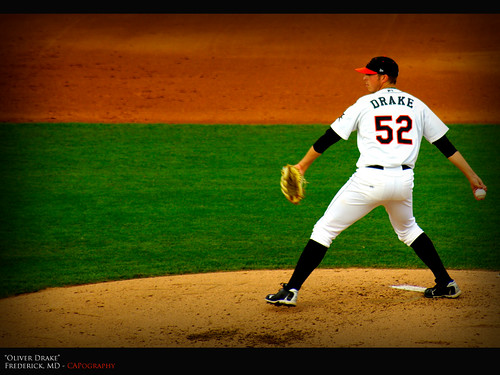
Arizona Fall League Scouting Report: Oliver Drake


Oliver Drake(Baltimore Orioles)

Age: 23

Bats/Throws: Right/Right

Height: 6’4”

Weight: 220

From: Navy (43rd round of 2008 draft)

The Orioles have a stable of young pitching prospects that are ahead of Drake as far as organizational depth is concerned, but Drake can still contribute on a major league level at some point in his career. That’s more than you normally get out of a 43rd round pick, one of the last rounds in the draft. He wouldn’t have gone that late if teams knew he was draft eligible as a sophomore but a lot of teams were unaware. Fewer still realized that Drake could bypass his military commitment if he dropped out of the Naval Academy. The relationship he developed with the O’s scout assigned to his region allowed him to be comfortable to do so and he signed for $100,000.

Stuff:

Drake has a low 90s fastball that topped out at 92mph when I saw him. He can cut it but loses some velocity when he does. His slider is good enough to offset opposing righties but his straight changeup is not good enough to neutralize opposing left handers. His stuff is not good enough to plow through a major league lineup 3 or 4 times.


Mechanics:

Drake has an over the top delivery. His arm action lacks deception and is a little stiff. While his delivery does incorporate some effort, it isn’t an ultraviolent action (see Scherzer, Max) that would point toward future injury or anything like that. Combine acceptable mechanics with his large frame and he profiles as a guy who can give you multiple innings.

Numbers:

Drake has struck out a respectable 7 batters per 9 innings throughout his pro career but has recently struggled with walks. Combine the walks with fringy stuff and you’ve got a guy who gives up 1.40 base runners an inning which is not a good number. I don’t think Drake will be good enough to plow through a major league lineup 3 or 4 times. At most he profiles as a long, innings eating reliever who comes in to soak up garbage innings.

Future MLB Comparison: Dave Herndon

Wednesday, October 27, 2010

Arizona Fall League Scouting Report: Josh Vitters


Josh Vitters

Age: 21

Bats/Throws: Right/Right

Height: 6’2”

Weight: 200lbs

From: High School (Cypress, CA)

The Cubs seem to be perpetual disappointments. It seems every year they have a bunch of players that have uncharacteristically poor years. This year they had several, including Derek Lee, Carlos Zambrano and most applicably to this post, Aramis Ramirez. The potential heir apparent to Aramis is Vitters, who was the number 3 pick in the 2007 Draft.

Offense

Vitters has one of the nicest swings I’ve seen from someone this young. He took the ball the other way in BP, which is a good sign and I don’t remember seeing him swing and miss at a single pitch all weekend so he has good hand-eye coordination, enough that he’ll be a .290+ hitter in the majors one day. He has the power to regularly hit between 20 and 25 HRs a year.

However, he has an extreme lack of patience and plate discipline. Vitters walks in just 6% if his plate appearances and hasn’t posted an OnBase% higher than .300 since he was in Low-A ball as a 19 year old. This is a huge problem and one that will limit his value if he does not improve.

Defense

Vitters looked good defensively when I saw him, which is refreshing considering that his reputation as a defensive liability was growing. Now he’s not Adrian Beltre or anything, but he had decent hands and footwork and definitely has the arm to play 3rd. Some scouts though he’d eventually have to move to first base which would destroy his value because he likely won’t get on base enough to be an effective regular there.

Future MLB Comparison: Pablo Sandoval

Arizona Fall League Scouting Report: Engel Beltre


Engel Beltre
Age: 21

Bats/Throws: Left/Left
Height: 6’1”

Weight: 169lbs

From: Dominican Republic

Congratulations to the Texas Rangers on their American League Championship. Not only do you have a chance to win the world series but you still have some nice pieces in your farm system for the coming years. One of those pieces in Engel Beltre.

Beltre was signed for $600,000 out of the Dominican by the Red Sox who included him in their trade for Eric Gagne at the 2007 trade deadline. He’s always had an impressive set of tools but it looks as though he is beginning to put it all together and may be ready for the major leagues toward the end of next season.

Offense:

Beltre has great bat speed. He can let the ball travel deep in the zone before he swings which allows him to spray the ball all over the field. He loads his hands a little deep, almost barring his lead arm so he might have trouble hitting inside pitches. He gets his weight back well and loads his hips, creating excellent rotation and leverage as he brings his weight forward with his swing.

Beltre doesn't have great plate discipline (he’s only walked 75 times in4 years of pro ball) and he swung an awful lot while I got to see him. At 20 years old he’s getting past the point where we can just wave off his lack of walks as a product of his youth. Only one major leaguer had as many PA as Beltre did in 2010 (488) while drawing fewer walks (A.J. Pierzynski, with 15), and it's time for Beltre to be more selective so he can start using his other offensive gifts. The plate discipline issue is more a lack of patience (perhaps the "I can hit everything" problem) than a lack of pitch recognition, because he seemed to have the ability to recognize breaking stuff and adjust accordingly.

Defense:

He's an above-average runner with an above-average arm and should be able to stay in center field. I didn’t see him have to make any tough plays or get a read on the routes he takes to balls but things I’ve read indicate he has good instincts and could be an elite defender in Center.

Future MLB Comparison: Austin Jackson