Sunday, June 3, 2012

MLB Draft Prospect Scouting Report: Joe DeCarlo


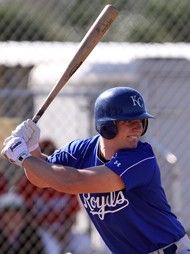
The Northeast is perpetually understocked on amateur baseball talent.  It is the nature of the meteorologically uncooperative beast.  There’s not much to see up here, a problem compounded this year by one of the weaker draft classes the industry has seen in a while.  All that made seeing Garnet Valley High School shortstop, Joe DeCarlo, my top amateur scouting priority of the Spring.  A top 60 recruit on his way to Georgia, I scouted DeCarlo twice and both times left underwhelmed.  Don’t get me wrong, DeCarlo is a talented young man and there’s plenty to like about him (and I’ll get into all that in a minute), it just didn’t look to me like this was one of the top high schoolers in the country.  In fact, between what I saw and the report from Baseball America’s Nathan Rode that DeCarlo was likely to be selected somewhere between rounds six and ten, I had all but decided against spending time writing this report.  Then today ESPN’s Kiley McDaniel reported that teams were considering him in the sandwich round.  I can’t ignore that.   Let’s talk Joe DeCarlo.

Listed at 6’1”, 205lbs, DeCarlo actually looked to be about my height at 5’11” or so.  He is very physically mature for a high school kid, strong and muscular.  It’s nice to look at a kid who’s already physically mature and know what his body is going to look like as he ages since it already looks like that.  Conversely, there’s little to no room for DeCarlo to grow and the simple fact that his physical composition is unlikely to improve, that there’s no frame on which to dream, hurts his stock. 

Like most premium high school athletes, DeCarlo’s current defensive residence lies at shortstop.  His hands are terrific and his arm is slightly above average, both adequate for the position.  However, his instincts and feel for short are sub-par.  Combine that with the probability that age will impede upon his already fringy range and DeCarlo profiles at third base where he should be just fine.

Whenever an amateur’s defensive profile pushes him to a corner, you have to ask yourself if his bat will be strong enough to carry him to the majors.  DeCarlo’s bat is interesting albeit unconvincing.  It’s a simple swing that doesn’t produce as much power as the body would indicate.  Failing to extend his hands most of the time, DeCarlo took swings for scouts with a wooden bat after one of the games I attended and failed to do little more than pepper his high school field’s outfield with fliners.  There are issues with his base that can be iron out with good coaching.  It’s not a stretch to think that the team that selects DeCarlo will do some mechanical tweaking to see if the pop can be unleashed.  In games DeCarlo shows signs of advanced pitch recognition for his age.  If embarrassed by a good breaking ball once, the adjustments were made to prevent it from happening again.

For what it’s worth, he has a fantastic taste in neckties.

So there’s a lot to like about Joe DeCarlo but also plenty to be skeptical about.  In a weak draft class, it’s not moronic to think a team that’s had a good look at him will make an early move. As a Philly kid, I’ll certainly be rooting for him.


Friday, May 25, 2012

Domonic Brown: Supernova


I have to accept the fact that I’m going to be wrong quite a bit in this business.  The world of prospecting has a higher rate of failure than any profession this side of meteorology and learning to deal with my own misevaluations as well as the vitriol generated therefrom is a process I’m becoming more familiar with as both the kids I scout and I age.  I’m not alone.  Go crack open any Baseball America Prospect Handbook from the past half decade and see just how wrong everyone (the pundits and the scouts which they use as a supplement to their own opinions) is all the time.  The 2008 BA Handbook has names like Joba Chamberlain, Travis Snider, Franklin Morales and Brandon Wood scattered about the entire sport’s top 15 prospects. From elite to extinct, such is the fate of far too many talented young ballplayers.  Prospects fail all the time. I’ve known this since I started pursuing the art of scouting while I was in college and for the most part, I’ve made peace with it. So why do I feel nauseous when I even entertain the idea that it might be happening to Domonic Brown? Because he might not just become a mistake, he might become my mistake.

If any outsider should know what has gone wrong with Brown, it should be me.  I was there, after all, for most of the roller coaster ride that has been Brownie’s career during the past few years.  A lowly intern/usher for the Phillies Triple-A affiliate during my college summers, I was the guy who would show up early on work days to watch BP, bug the scouts sitting there in their awful polo shirts and scribble in my notebook during games as I fumbled with my stopwatch which I constantly dropped.  I was a terrible employee, but I was becoming a damn fine scout.  I’ll never forget the humid afternoon Brown came up from Double-A and proceeded to litter the parking lot beyond the Philly Pretzel stand in right field with batting practice missiles.  It didn’t take long to see that everything was there.  Above average speed, an above average arm, advanced approach and pitch recognition for his age, average present power with projection left in the body and dreams of above average defense in an outfield corner as he grew into his lanky, 6’5” frame and became more coordinated.  Gracing magazine covers and webpage headlines, Brown was on top of the prospect world.

Between then and now, something has gone horribly awry.  Brown hasn’t homered since August 2nd of last year.  His swing, especially the lower half, is a mess.  He’s constantly late on good velocity.  His misadventures in the outfield are excruciatingly awkward, and not the sort of “Hunter Pence/Larry David, I’m weird but I don’t give a shit and I make it work” awkward, but more of a “Michael Cera, self aware, it’s so bad I need to divert my eyes” awkward.  He sports a sub-.300 OBP to this point and has just 3 steals at a paltry 50% success rate.  People, possibly including the Phillies front office, are giving up.
The causes of this tragic collapse are difficult to nail down.  Scouts are perplexed.  I asked Baseball Prospectus writer, Kevin Goldstein, to comment on Brown:

“I’m confused too…everyone is.”

The response’s simplicity juxtaposes how complicated the problems probably are.  I have my theories, of course.  In my opinion this shit sandwich was spawned from some combination of the tinkering Phillies instructors did with Brown’s swing upon his first arrival to the majors, the long lasting effects of the broken hamate bone Brown suffered last year, the constant jerking back and forth between the majors and minors he has endured and whatever psychological trauma has eradicated his confidence as a result of all that stuff I just mentioned.  It’s a developmental cocktail mixed to induce failure and Brownie has had to drink it. 

The worst part is that all of this is happening at a time when the Phillies big league roster has begun to crumple into a mediocre, geriatric heap.  It’d be nice to have an infusion of offense and youth into the lineup, but without performing well in the Lehigh Valley, there’s little justification to promote Brown and anoint him the savior.  While I’m discouraged, there’s too much talent there to lose all hope, and I’ll be monitoring Brown carefully (I watch every single one of his at bats on MiLB.TV every day) waiting to drink from the cup that still runneth over with ability.  For now, while he tries to work things out, he’ll be booed on a regular basis by ignorant old men who know nothing beyond the fact that Brown was a top prospect who isn’t panning out.  It can’t be easy and it can’t be fun.  

As much as I’d like to give Domonic Brown an elixir to solve his baseball problems, I’d like to give him a manly hug and tell him that some of us realize this mostly isn’t his fault and that we’re not giving up on him.  After the vigor and conviction with which I once touted Brown’s future stardom, I might need one too.   

Friday, April 20, 2012

MLB Draft Prospect Scouting Report: Matt Bowman

Princeton two-way player Matt Bowman had a little bit of heat on him when I caught the Tigers double header against Harvard a little while ago. Scouts from Toronto, Cleveland and San Diego were in attendance and two-thirds of them left after Bowman pitched, neglecting to see him play shortstop, at least on this afternoon. It makes sense since it seems clear Bowman's best chance to make an impact at the professional level is on the mound rather than at short.

See?
At just 6'1", 175lb, Bowman will have the "short righty" stigma working against him in draft war rooms. He's quite skinny, skinny enough that he could put on weight without his stuff/tools going backwards and maybe even add a little velocity if he gets stronger in the right places (his legs). Bowman's diminutive stature means he needs to incorporate his entire body in his delivery to generate the velocity he'll need to compete in the pros. For the most part he does it, utilizing his lower half (It's clear when you watch Bowman's mechanics that he's doing his best Tim Lincecum impression) to launch himself off the mound . After watching video from 2011 you can tell Bowman has lengthened his stride and continuing that trend while adding muscle in his thighs and ass might yield a bit more heat. He has the athleticism to repeat a delivery of this type. The top half of Bowman's over-the-top delivery is fine. There's no extreme violence that would raise concerns about his ability to throw strikes or indicate a heightened risk of injury.

Bowman's stuff doesn't blow you away but it's nothing to scoff at. His fastball sits 88-89mph touching as high as 91mph. That's average velocity but the pitch plays down a bit due to how straight it is both vertically and horizontally. Bowman is already at a disadvantage due to his height. He's not going to get natural downhill plane on his fastball. At the next level he's going to have to find a way to make the heater wiggle or sink.

Bowman features three secondary offerings; a changeup, curveball and slider. Of the three, he worked most often with a low-70s curve which suited him just fine against Ivy League hitters but likely won't garner swings and misses from professionals. It has decent depth but its break isn't sharp. The slider shows much more potential. It was inconsistent but flashed nasty, two-plane movement here and there. Scouts nearby mentioned their desire for him to use it more often. Bowman's most consistent offspeed pitch was his changeup which sat in the upper 70s. It showed promising fade and run but Bowman noticeably decelerates his arm.

Other ancillary stuff you might want to know about Bowman:

He obviously fields his position well since, when he's not pitching, he's playing shortstop.

He holds runners well. I timed him in the 1.25-1.35 second range from the stretch. He varies the height of his leg kick from the stretch as well, to screw with baserunners and the timing of the hitter.

Bowman is a slightly below average runner, timed at 4.35 seconds from the right side from home to first.
He is adequate at shortstop, not spectacular, and I'm bearish on his ability to hit at the next level.

Other note: Bowman's teammate Sam Mulroy is a pretty interesting prospect in his own right. He's an above average runner who plays center field, third base and catches. It takes a few trips to properly scout a swiss army knife like Mulroy. I'd like to see him again if I can, but the drive may prevent me from doing so.

Thursday, April 19, 2012

MLB Draft Prospect Scouting Report: Chris Burke


“The hardest thing about this is figuring out who the hell is going to hit.”

Almost every scout I’ve pestered over the past two years has expounded some version of that statement.  It’s true.  Understanding swing mechanics is the most difficult task I’ve undertaken since deciding to try my hand at this scouting thing.  It gets harder as you venture down to A-ball and harder still when you’re looking at amateurs.  Thankfully when I went to scout Iona 3B Chris Burke I had a double header’s worth of at-bats to look at.  I made the most of them, and so did Burke.

At a listed 6’1”, 195lbs, Burke has little projection left in his body.  He could get bigger, sure, but he’s not presently the most limber and agile individual so I’d advise against it.  A bigger, slower Burke means a move to an outfield corner or across the diamond to first base and his value would suffer.  I already have questions about Burke at third base.  He has slightly above average arm strength, enough to play the position, but he struggled with accuracy.  His reactions and hands are both unexceptional.  Of course whichever team drafts Burke needs to let him play third base where he’ll simply sink or swim.  His best chance to make noise in the big leagues is at the hot corner.  He’ll need to sort out his deficiencies there to make it, mechanical, mental, whatever.

Unfortunately I was unable to arrive early enough to evaluate Burke in the cage.  While certainly regrettable, I still managed to get several looks from the appropriate perpendicular angle that is optimal for evaluating swing mechanics.  Burke’s motions are fluid and fast, but what impressed me most was how quiet everything was.  Shoulders between the knees, knees between the feet, barely a stride, clean, simple and fast.  Burke keeps his hands inside the ball allowing him to drive balls to all fields.  He absolutely wrecked Lehigh pitching when I saw him.  He didn’t see a ton of pitches but you can’t blame him since the pitches he decided to swing at were obliterated. 

Burke has a bat, but is it enough bat to profile at a corner? I can’t help but be concerned about the level of competition he’s facing.  If he cleans up the defense he has a shot.

Monday, March 19, 2012

MLB Draft Prospect Scouting Report: Brendan Close (Moravian College)


I had an opportunity to shake off the rust that had accumulated over my eyeballs during the offseason and see Moravian righty Brendan Close on Saturday.  Baseball America pointed their omnipotent finger at Close when they mentioned him in a preseason write up on small school prospects to watch this spring.  Clearly the best player on the field as the Moravian Greyhounds swept a double header from the Catholic University of America, Close has enough raw talent that teams will view him as at least a little more than a senior sign.  He’s not a guy a team will bring on just to help fill the roster of one of their lower level affiliates.  There is a chance, albeit a small one, that Close can find a niche and become a legitimate prospect.  We’ll get into all that in a minute.  For now, I’m going to take the next few seconds and enjoy the fact that a kid this talented fell through the cracks and ended up at a D-III school.  People at Lehigh, Lafayette, Temple and Penn State are paid to find kids like this.  None of them did.  I find solace knowing that the industry is still not very good at mining baseball talent.  I’ll be paid to do this one day, I swear to Christ.  On to Close.

Delivery

At an athletic 6’4”, 200lbs, Close has just a little projection left in his body.  He has the athleticism to put on a little more weight and maintain his mechanics.  He’ll have to maintain that delivery as is because if it were to get any worse it would become an issue.  While Close’s straight over the top arm action isn’t anything to be concerned about, there’s plenty of noise from the shoulders up.  His head whips around quite a bit possibly causing him to lose sight of the plate momentarily.  It causes his command to suffer a bit. 

Stuff

Close has an interesting repertoire, consisting of a fastball, curveball, cutter and changeup.  He works primarily with his fastball which sits between 87-89mph and touches as high as 92mph.  It has some run, especially when he’s working to his arm side.  The velocity is average but it’s far too much for hitters at this level to handle.  Close relies on it almost too heavily.  Why shouldn’t he?  It gets the job done.  That’s fine for now, but his secondary pitches are underdeveloped as a result.

When Close does work with the secondary pitches the results are a bit underwhelming.  The curveball has a nice, sweeping, two plane shape to it, but it’s a little soft and loopy.  The cutter moves plenty, so much so that I thought it was a slider before I was corrected by his teammate, Ben Hammel.  The cutter has its moments but again, the movement isn’t very crisp much of the time.  Close tried to back door these pitches against lefties in the first inning and got hit around a bit.  He doesn’t use the changeup very much.  He barely even threw it during between inning warm-ups.  His arm slot is suited beautifully for a splitter and I hope whatever minor league pitching coach gets a hold of him after he signs recognizes that. 

Secondary Skills

Close walked five hitters in eighty innings of work last season.  I showed up thinking I’d see plus control and command.  Close’s control is a true 60 on the scouting scale, but the command doesn’t grade out the same. He left several pitches up.  I am mindful that Close was making his first start after an injury and was likely a tad rusty.  I will see him again later this season and post an update.  For now, I’m going to refrain from expounding about what I’d do with Close to improve his chances of making the big leagues one day.  I’ll do that later this season.  He shouldn’t be worried about that stuff right now anyway. 

Scouting Grades:

Fastball: 50
Curveball: 40
Cutter: 40
Changeup: ? (need to see more of it)
Control: 60
Command: 40
Delivery: 50

Sunday, February 12, 2012

Eastern PA College Baseball Prospects


It's nearly that time of year.  Baseball time.  Opening Day is April 4th with minor league games starting shortly thereafter.  That means you're still nearly two months away from meaningful ball.  Luckily, you have me to clue you in on some watchable stuff in the meantime.  What I have here is a schedule of all the notable college prospects within reasonable driving distance of Eastern Pennsylvania.  It's a small geographical area and this post isn't likely to net me hundreds of page views, but I made this schedule for myself as I look to get better at evaluating amateur prospects (vastly different than looking at minor leaguers) and figured it was worth sharing for anyone looking to do something similar.  Here's stuff you should know about this schedule:

- Be sure to check out the college's athletics webpage a few days prior to attending these games.  Game times change all the time due to weather or any number of external factors.  You don't want to drive for two hours and learn that the game you planned on seeing is already half over because they moved the start time up to avoid a potential rain shower.

- The "DH" after the time denotes a double header.

- The number preceding the player's name indicates their ranking as a prospect in their conference, according to Baseball America. So, Kyle Hansen is the #3 prospect in the Big East.

- If you're trying to look at a pitcher, make sure you're checking box scores to see what day of the week he's pitching.  Th team's best pitcher is likely to throw on Friday nights, but team's with weird schedules and multiple pitching prospects might have an anomalous rotation.

- Moravian pitcher Brendan Close belongs on this schedule, but I live so close to campus that I can scoot over there any time I want to.  I don't have a set date to see him for that reason. I'll get to him when I have time.  The same can be said for Joe Wendle.


Date Game Time Players
1-Mar West Chester at Chestnut Hill 3:00pm  Joe Wendle, 2b, West Chester
9-Mar Iona at St. Joe's 3:00pm  4. Chris Burke, 3b, Iona
10-Mar Iona at Villanova 1:00pm 4. Chris Burke, 3b, Iona
11-Mar Iona at Temple 12:00pm 4. Chris Burke, 3b, Iona
         
17-Mar Iona at Lehigh 12:00pm DH 4. Chris Burke, 3b, Iona
18-Mar Iona at Lehigh 12:00pm DH 4. Chris Burke, 3b, Iona
         
23-Mar St. John's at Villanova 3:00pm  3. Kyle Hansen, rhp, St. John's
2. Jeremy Baltz, of, St. John's
11. Matt Wessinger, ss/2b, St. John's
         
24-Mar Bucknell at St. Joe's 12:00pm DH 2. Taylor Runge, rhp, Bucknell
St. John's at Villanova 1:00pm 4. Matt Carasiti, rhp, St. John's
11. Matt Wessinger, ss/2b, St. John's
         
25-Mar Bucknell at St. Joe's 1:00pm 5. Ryan Ebner, lhp, Bucknell
St. John's at Villanova 12:00pm 2. Jeremy Baltz, of, St. John's
11. Matt Wessinger, ss/2b, St. John's
         
30-Mar Rhode Island at St. Joe's 3:00pm  2. Mike LeBel, ss/rhp, Rhode Island
Richmond at LaSalle 3:00pm 4. Adam McConnell, ss/3b, Richmond
Monmouth at Temple 12:00pm 1. Pat Light, rhp, Monmouth
5. Dan Smith, lhp, Monmouth
31-Mar Rhode Island at St. Joe's 1:00pm 2. Mike LeBel, ss/rhp, Rhode Island
Richmond at LaSalle 1:00pm 4. Adam McConnell, ss/3b, Richmond
         
1-Apr Rhode Island at St. Joe's 12:00pm 3. Chris Pickering, lhp, Rhode Island
Richmond at LaSalle 1:30pm 4. Adam McConnell, ss/3b, Richmond
Harvard at Princeton 12:00pm DH 1. Matt Bowman, ss/rhp, Princeton
2. Sam Mulroy, c/of, Princeton
3. Brent Suter, lhp, Harvard
4. Michael Fagan, lhp, Princeton (2013)
         
5-Apr Notre Dame at Seton Hall 1:00pm 8. Ryan Harvey, rhp, Seton Hall
6-Apr Notre Dame at Seton Hall 4:00pm 13. Trey Mancini, 1b, Notre Dame (2013)
7-Apr Notre Dame at Seton Hall 1:00pm 13. Trey Mancini, 1b, Notre Dame (2013)
13-Apr Charlotte at Temple 3:00pm  1. Tyler Barnette, rhp, Charlotte (2013)
Georgetown at Villanova TBA 10. Rand Ravnaas, of, Georgetown
         
14-Apr Charlotte at Temple 3:00pm  5. Andrew Smith, rhp, Charlotte
Georgetown at Villanova TBA 10. Rand Ravnaas, of, Georgetown
         
15-Apr Charlotte at Temple 1:00pm 5. Andrew Smith, rhp, Charlotte
Georgetown at Villanova 12:00pm 10. Rand Ravnaas, of, Georgetown
20-Apr Richmond at Temple 3:00pm  4. Adam McConnell, ss/3b, Richmond
         
21-Apr Richmond at Temple 1:00pm 4. Adam McConnell, ss/3b, Richmond
Holy Cross at Lehigh 12:00 DH 1. Mike Ahmed, 3b/rhp, Holy Cross (2013)
Navy at Lafayette 12:00pm DH 3. Alex Azor, of, Navy
         
22-Apr Richmond at Temple 1:00pm 4. Adam McConnell, ss/3b, Richmond
Holy Cross at Lehigh 12:00 DH 1. Mike Ahmed, 3b/rhp, Holy Cross (2013)
Navy at Lafayette 12:00pm DH 4. Ben Nelson, rhp, Navy
27-Apr Colombia at Penn 12:00pm DH 5. Pat Lowery, rhp, Columbia
         
28-Apr Bucknell at Lafayette 12:00pm DH 2. Taylor Runge, rhp, Bucknell
         
29-Apr Bucknell at Lafayette 12:00pm DH 5. Ryan Ebner, lhp, Bucknell
         
8-May Monmouth at Seton Hall 3:00pm  8. Ryan Harvey, rhp, Seton Hall
1. Pat Light, rhp, Monmouth
5. Dan Smith, lhp, Monmouth
17-May Rhode Island at Temple 2:00pm 2. Mike LeBel, ss/rhp, Rhode Island
18-May Rhode Island at Temple 2:00pm 2. Mike LeBel, ss/rhp, Rhode Island
19-May Rhode Island at Temple 1:00pm 3. Chris Pickering, lhp, Rhode Island

Sunday, January 22, 2012

MLB Showdown Needs


From time to time I spend some discretionary income trying to fill in my MLB Showdown collection.  Below is a list of cards I still  need and HERE is a list of cards I have to trade.  Feel free to post in the comments section or email me to talk about trading like we used to do on the ShowdownCards Forum back in the day.

2000 Pennant Run: None

2001 Base Set: None

2001 Pennant Run: None

2002 Base Set: None

2002 Trade Deadline: None

2002 Pennant Run: Randy Johnson (’95 Mariners Super Season), Roberto Alomar (’93 Blue Jays Super Season), Trevor Hoffman (’98 Padres Super Season)

2003 Base Set: None

2003 Trade Deadline: None

2003 Pennant Run: Carlos Baerga (1993 Super Season),

2004 Base Set: NONE

2004 Trade Deadline: Bob Gibson

2004 Pennant Run: Danys Baez, Jim Palmer

2005 Base Set: David Ortiz, C.C. Sabathia, Armando Benitez, Cesar Izturis, Mike Piazza, Ichiro, Jim Edmonds, Francisco Cordero

2005 Trade Deadline: Brooks Robinson, Rod Carew, Nolan Ryan