Here's a quick look at every MLB team's actual wins compared to what their theoretical record would be based on the team's aggregate Wins Above Replacement. If you don't understand what that means, allow me to explain.....
Baseball statistics are so great that we can essentially quantify the value each player contributes to the team. The crown jewel of these statistics is Wins Above Replacement (WAR) which measures how many WINS a given player is worth to his team ABOVE what a REPLACEMENT player would be worth. A replacement player is defined as, in short, the value provided by an organization's best minor league player.
So here's how I calculated my stuff to test WAR's validity: I multiplied the number of games each team played by what their winning percentage would be if the entire team was made up of replacement players. This gave me how many wins a team full of replacement players would have won at this point in the season. I then added to that total the number of Wins Above Replacement every team's hitters and pitchers have provided so far this year with WAR stats provided by Baseball Reference. This gave me how many wins each team should have based on their aggregate WAR. I then compared that to how many wins they actually have. The results clearly show the WAR stat is a terrific way to quantify the value each player provides to the team, since the theoretical WAR wins and actual wins are almost identical in nearly every instance. Teams that have more actual wins than WAR wins (Braves) are likely the beneficiaries of good luck during the first half of the season while teams with less wins than WAR wins (Angels, Yankees) were victims of unkind randomness.
Eric Longenhagen is a 22 year old male who hails from the tiny Pennsylvania town of Catasauqua. He frequents minor league baseball games to scout baseball players and he one day hopes to be paid to do so.
Wednesday, July 13, 2011
Saturday, July 9, 2011
MLB Prospect Scouting Report: Devin Mesoraco
Devin Mesoraco
Age: 23
Bats: Right
Height- 6’1”
Weight- 220lbs
From: Punxsutawney High School, PA (drafted 15th overall in 2007)
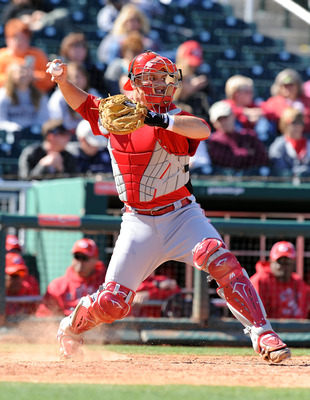
Reds catching prospect Devin Mesoraco would likely already be in the majors if not for Ramon Hernandez and Ryan Hanigan. Both of those veterans are having fine years as they split catching duties down the middle for the Red Legs. Part of the reason the Reds brought back Hernandez on a 1-year deal (and maybe drafted Yasmani Grandal, another catcher, in the first round of the 2010 draft) was due to Mesoraco’s slow progress in his first three professional seasons. From 2007 through 2009, Mesoraco only got on base 31% of the time and hit a total of 18 HRs. Most of these struggles can be attributed to recurring injuries to his hands and wrists. In 2010, Mesoraco was healthier and broke out, popping 26 HRs as he tore up Hi-A and AA, reaching AAA Louisville by the end of the summer. This season, his first full AAA season, Mesoraco continues to rake, boasting a .303/.378/.510 line. He’s just about ready for the big leagues.
Offense: Mesoraco has terrific leverage in his swing and generates a lot of torque with his body by rotating his hips during his swing. This allows him to hit with above average power. When his hands and wrists are healthy, that could even improve. His bat is quick and he’ll likely hit for a good average to go along with the power. He’s about an average runner, unlike most catchers, so he may even add some value on the bases.
Defense: Mesoraco will likely stick as a catcher but he’s not great defensively. He has a great arm but his transfer adds some unwanted ticks to his pop time. Watching Mesoraco in the Arizona Fall League last year led some to believe that he’d have to move out from behind the plate because he struggled to simply catch the ball, especially from pitchers with good velocity. Now we know that Mesoraco had suffered another finger injury that hindered his ability to handle pitches cleanly. I saw Mesorcao catch 3 games in a series this year and he was much better.
Overall, the Reds have an above average starting catcher on their hands with the potential to make an All Star team or two. I think Mesoraco will be given every opportunity to win the starting catcher’s job in Spring Training of 2012 and contribute to a very good Reds team next year, as long as Dusty Baker doesn’t get in his way.
Labels:
Cincinnati Reds,
Devin Mesoraco,
scouting
Friday, July 1, 2011
MLB Prospect Scouting Report: Yonder Alonso
Yonder Alonso
Age: 24
Bats: Left
Height- 6’2”
Weight- 210lbs
From: The U (Miami) Reds 1st rounder in 2008
Reds first base prospect Yonder Alonso is a name you’ll likely hear as a potential trade chip before this month’s trade deadline. The Reds have holes to fill and Alonso plays a position they have filled with a guy who I hear is pretty good, Joey Votto. The Reds front office obviously likes Alonso’s bat enough that they’ve pumped coaching resources into his defensive development (more on that “development” later) but his progress was slowed when he broke his hand toward the tail end of 2009. He didn’t fully recover from that hand injury until half way through the 2010 season, finishing with a .296/.355/.470 line in 400 at bats at AAA Louisville.
Offense:
Alonso has a terrific approach, running deep counts and working walks with impressive regularity. He sprays the ball all over the field thanks to his simple (especially below the waist) balanced swing. The bat speed is good and there’s some leverage in the swing though Alonso hasn’t hit for as much power as you’d like to see from a first round-first base prospect. While some of that can be attributed to the broken hand at the end of 2009 I think a lot of it has to do with Alonso’s hip rotation (or lack thereof) in the swing. He’s obviously not very flexible and the hip rotation that generates torque in the swing just isn’t there. Some scouts think the power will come, but I do not. It would have been here already.
Defense:
Alonso could be an adequate first baseman, but the Reds have been trying him in left field, hoping that he can fake it out there and come up to the big leagues to steady the revolving door of garbage (apologies to Chris Heisey, who I think is pretty good) they have up there. They even tried him at third base but that went horribly, to put it mildly. Alonso is slow of foot and is obviously uncomfortable in the outfield. Even the most routine fly balls look like an adventure. He does have an above average arm for a left fielder, but it’s more likely that he’s a first baseman only.
On the continuum of first base prospects, I like Alonso more than Freddie Freeman but less than Brandon Belt. I think it’s likely the Reds find a trade partner before the deadline and that Alonso’s name comes up in the talks, maybe for someone who can replace Edgar Renteria’s corpse and Paul Janish at shortstop. I think he’ll be an above average major leaguer.
Orange and Black Listed
BY ERIC LONGENHAGEN I’m going to keep this short because I don’t want to waste too much time on either of these guys. Last week the Flyers traded away two of their best players, Jeff Carter and Mike Richards, for a prospect pu-pu platter in order to clear cap space to sign a terrific goalie, Ilya Bryzgalov. Good riddance.Carter and Richards were the face of the Flyers in the post-lockout NHL, a new-look league which underwent drastic rule changes in order to promote scoring and attract more casual fans. They knew it, and took full advantage. Both guys were seen drinking and partying into the wee hours of the morning in Philadelphia with a considerable degree of regularity; whether they had work the next morning or not. They’d crash St. Joe’s or Temple frat parties and enjoy the company of girls, typically seven to eight years their junior. Sure, they’d arrive to the Wells Fargo Center the next day, throw on their sweater and play some terrific hockey, but they never optimized their talent nor approached the sport with an urgency or passion that reciprocated the intensity of the fan base. They worked as hard as was needed to maintain an above average level of play and stay famous in the city, allowing them to maintain their playboy lifestyle.
I realize Richards and Carter have the right to do what they want in their free time. They haven’t driven drunk or sexually assaulted anyone or done anything explicitly wrong. If they want to party and have a good time, that’s their prerogative and they
certainly should be able to. It’s a free country. But just as Richards and Carter can act as they chose to, I can react to and judge those actions.
certainly should be able to. It’s a free country. But just as Richards and Carter can act as they chose to, I can react to and judge those actions.That being said, I condemn them as morons. They are kind of people who act like this:
They are not people who I want to work or hang out with, and certainly not people I want to root for 82 games each winter for the next ten years. Richards and Carter broke the fourth wall and assimilated themselves into the culture of our city. I did not like what I saw and am glad they’re gone. I wish them both the best of luck as they troll for freshman girls at UCLA and Ohio State next season.
Labels:
Jeff Carter,
Mike Richards,
Philadelphia Flyers,
rant
Dodger Blues
BY ERIC LONGENHAGEN About a week ago I posted a piece that chronicled the despicable way the Florida Marlins leveraged their way to a new stadium on the taxpayer dime. Sadly, I didn’t get too far before running into another tale of greed and corruption that bears reporting. I’m talking, of course, about the McCourt Family, owners of the Los Angeles Dodgers.If you follow baseball at all you probably already know that the Dodgers are broke. They’re struggling to meet payroll requirements every month and attempting to fight off Major League Baseball’s efforts to seize control of the organization. While it seems like the Dodger’s debt problems manifested unexpectedly out of the abyss, anyone who has taken zero days of business classes could have seen trouble coming as soon as Frank McCourt bought one of baseball’s most storied franchises.
In order to understand how awful the McCourts are, we need to start from the beginning. The narrative of financial irresponsibility that follows comes from information published on DodgerDivorce.com, a site which is operated primarily by a man named Josh Fisher who has become a Robin Hood of sorts for Dodgers fans on the web.
Frank McCourt graduated from Georgetown University in the mid-70s with a degree in economics (this will be hilariously ironic as you continue to read). He married his college sweetheart, Jamie (the story’s other anti-hero), shortly after graduating. Right around that time, McCourt purchased some large plots of land in South Boston and turned them into parking lots. This is how Frank McCourt made most of his money, by owning parking lots in South Boston. You’re probably wondering how the hell someone could afford to buy a professional sports team, let alone a baseball team in America’s second largest media market, when the buyer’s primary (and really only) source of income comes from a parking lot in Southie. Here’s how McCourt did it: He bought the Dodgers from a company called News Corp with $150 million he borrowed from Bank of America, $75 million he borrowed from Major League Baseball and a $196 million debt package from Fox (which is associated with News Corp, which Rupert Murdoch founded). That total comes to $421 million of debt.
As if that weren’t bad enough, shortly after the purchase McCourt traded his precious parking lots to Fox in exchange for forgiveness of some of the debt. That would have been fine if those lots weren’t the only source of his income. McCourt essentially traded his parking lots for the Dodgers and $350 million worth of debt. Now the Dodgers are McCourt’s only source of income, which means he essentially bought the Dodgers with their own credit card, as he’ll be paying for his acquisition of the team with money the team makes him.
Quick tangent: Sports owners should not be relying upon the team’s operation as a primary source of their own income. If you’re an aspiring sports owner, don’t buy the team unless it’s going to be a toy you’re willing to lose money to play with.
Once McCourt had control of the Dodgers, he and his wife Jamie started to use the organization as their personal piggy bank. Former Dodgers’ Executive Vice President Jeff Ingram has stated that the Dodgers molded the franchise’s fund allocation to fit the personal demands made by the McCourts. Essentially, the line between the family checkbook and business checkbooks was not only blurred, it didn’t exist. Ingram actually testified that the family used the team like a “credit card”. We’ll get into why Ingram was “testifying” later, but you might already know.Let’s detail some of the debauchery, shall we? We’ll start with salaries. Jamie McCourt received $2 million annually for her “services” as Dodger CEO. Frank McCourt received up to $5 million annually from one or more businesses affiliated with the Dodgers. That’s his salary, not Dodgers profit. His salary is deducted as an operating cost so it actually looks like an expense on the balance sheet. The Dodgers also paid up to $600,000 in annual salary to the two McCourt kids, one of whom was attending Stanford University and the other of whom had a full-time job at Goldman Sachs. Unless the former child was scouting the Pac-10 baseball scene for the club and the latter was helping to manage the team’s finances, I’m going to go out on a limb and say those salaries were undeserved.
That was only the first $7.5 million. The McCourts were as good at spending money as they were at borrowing it. They bought four homes in Los Angeles, two near the Playboy mansion (I’m willing to bet that was Frank’s idea) and two in Malibu. Combined, and with the additional cost of home improvements which included replacing massive tennis courts with a giant swimming pool, an operation which cost more than $10 million alone, the homes cost a hefty $90 million. Then there were the vacation properties, the private jet, the private drivers, the hairdresser who worked exclusively for the McCourts five days a week, and an 18-month period in which Jamie McCourt paid over $100,000 to various florists. The Dodgers were charged for the expenses.
It all came crashing down on the McCourts when their marriage went sour. That’s how the testimony I mentioned earlier came about, and really how all of this information became public. Sports teams are private corporations whose financial information only becomes available to the public if the info is leaked somehow. In this situation, the McCourts got divorced and the info came out during the court proceedings. Jamie was fired as CEO when Frank claimed she was shtupping her personal driver on a two and a half week vacation the two of them took to France, which the Dodger organization paid for, of course. Jamie filed for divorce and claimed ownership of half of the Dodgers. Normally a situation like this freezes spending on both sides, just in case the financial dominos of the divorce trial don’t fall the way either party wants them to. Not for the McCourts. Even with only four homes from which to pick, Frank has decided to stay in a Beverly Hills hotel’s luxury suite which costs $300,000 a month while Jamie is reportedly using one of those homes exclusively for swimming and another just to store furniture. Also remember both sides likely hired hoards of high priced lawyers for the divorce proceedings, which I’m willing to bet were paid for with revenue derived from the Dodgers.
This mess has sucked away the Dodger’s finances. It’s one thing for a team to have maxed out their payroll to a point where they can’t add any more players. It’s another when they’re so strapped for cash they can’t even pay the players they currently have on the roster. It became apparent they weren’t going to be able to pay their players. Frankie borrowed over $50 million from Fox to meet expenses in April then asked advertisers for an advance on funds that were originally supposed to be paid down the road. Those advances were paid at a discounted rate. McCourt tried to sell the naming rights to Dodger Stadium to Time Warner, but they wouldn’t bite. Despite these short sighted efforts to meet short term obligations, the Dodgers debt has reportedly climbed to $525 million. This is the point where Major League Baseball stepped in and began contemplating a takeover from above.
Frank McCourt made one last ditch effort to retain his throne. He had a tentative agreement in place with Fox, where Fox would fork over something like $3 billion in exchange for the television rights to Dodgers games for the next 17 years, as well as a $385 million loan, with $200 million of this loan going to the Dodgers, $80 million going to pay down unspecified indebtedness, and the remaining $93.5 million going to….wait for it…. the McCourt divorce settlement. If Comissioner Selig were to approve this agreement, then Frank McCourt would continue to own the team outright. If the deal is rejected by Selig, then the McCourt divorce settlement is nullified and litigation will resume. It would also be likely that Frank McCourt would sue MLB for wrongfully seizing the Dodgers from him, a suit which would get very messy and likely result in the disclosure of the financial documents of other teams in order for Selig to show cause for the seizure.
Thankfully, Selig rejected the proposed deal. It is likely the single greatest thing he’s done as Commissioner. Unfortunately, Selig is undoubtedly one of the biggest reasons McCourt was allowed to buy the Dodgers in the first place. Major League Baseball is a private club, they pick and choose who can join the group of owners. Selig is much more likely to approve of a potential owner who will operate as a submissive “yes man” and adhere to his outdated sermons from on high, than he is to approve of a forward thinking innovator who might challenge conventional wisdom (*cough*Mark Cuban*cough*) even if the wily owner is in a better financial position to own a team. That’s exactly what happened with McCourt and now baseball is wearing a scarlet letter “G” for greed thanks to the McCourt family’s gluttonous lifestyle. The situation will likely get worse before it gets better, but at least it’s going to change. It might actually benefit the league in the long run, since owners without real cash to buy a team won’t likely be approved (though, a recent report stated that 9 current MLB teams are in violation of the MLB’s debt ceiling and the Phillies are one of them). Purging people like the McCourts out of baseball is the first step the sport needs to take to regain prominence in the minds of American consumers. We’re closer to realizing that ideal today thanks to Jamie McCourt’s sex drive.
Labels:
Frank McCourt,
Los Angeles Dodgers,
rantnt
Oh......Canada
BY ERIC LONGENHAGEN Let’s be honest, Canadian people exist solely for our amusement*. John Candy, Jim Carrey, the Barenaked Ladies, Lorne Michaels, and the list of entertainers and even athletes goes on. It’s long and impressive, but lacks anyone of earth-shattering importance. The closest I can get is Terry Fox, whose inspirational attempt to run across his country inspired an all time tear-jerking ESPN documentary. As if that weren’t bad enough, when Canadians start to get too famous, the US swallows them up as one of their own. Even ESPN’s hockey analyst Barry Melrose has dual citizenship. Needless to say, this odd process has instilled a severe inferiority complex for our neighbors to the north. Rarely do they produce anyone of global significance, and when they have someone who even comes close, that person defects.
It all started when Wayne Gretzky left Edmonton for Los Angeles in the mid-80s. Even though there are plenty of things Canadians are really good at (they’re very environmentally conscious, and look better in flannel than everyone except Kurt Cobain) they struggle to make noise on an international level. As such, they desperately cling to the one thing at which they remain freakishly elite: Ice Hockey.
This week, a Canadian team chanced to win the NHL’s Stanley Cup (the best trophy in sports) for the first time since 1992. For the past 19 years Canadians have likely felt the same way Americans felt when the Team USA basketball team sucked at the 2004 Olympics. In those Olympics, the Americans were bested numerous times in a sport the country perfected (which, ironically, a Canadian invented) and the public was pissed. Now, imagine that same vitriol, wrapped in bacon and doused in maple syrup, simmering in the subconscious of all Canadians for almost two decades. That anger exploded this week in the Krakataon form of vicious riots when the Boston Bruins defeated the Vancouver Canucks in the Stanley Cup Finals.
Now, Philadelphia is itself known as a pretty angry city, as are most metropolises on the eastern seaboard. But I can’t see a sport related incident sparking a riot of this magnitude in our fair city unless something insanely deplorable happened to one of our athletes. Let’s enjoy some photos from the festivities, shall we:

I’m glad this young man had the tact and social consciousness to censor this sign for the riot. You know, in case there were kids around.

These guys are not fans of alliteration. The guy on the left is being sure to protect his lower back while he pilages.

You get the idea: I struggle to find words for my shock and anger at this lawless scene. That meter has clearly expired.

I can’t tell if this young Asian man intentionally busted the window with the stick or if he was just trying to park near the bank. How did that Teddy Bear get there?

I don’t think these guys were pissed about the Canucks losing as much as I think they just wanted to riot. The only previous anarchy in this guy’s life was his decision to leave his boot laces untied.

Get a picture of me looking cool and tough!” “Don’t you wanna get closer to the fire?” “No, it’s all hot.”

These brave men fought through their pollen allergies and continued rioting. Did these guys go home to grab their hockey sticks to riot with or do they always carry them? I can’t decide what’s funnier.
Schaudenfreude: Why we hate LeBron James
BY ERIC LONGENHAGEN Smiles crept across the faces of a large percentage of basketball fans Monday night, as the Dallas Mavericks sent the Miami Heat home for the summer without a championship. You know people really dislike someone when they are rooting for them to lose to a German and a multi-billionaire. The palpable disdain most Americans now have for the once affable LeBron James was at the center of this joy. I’m struggling to think of an athlete who went from being almost universally liked to being nearly universally admonished over the course of their playing career, let alone one who made that transition in under an hour like LeBron did. If you recall, LeBron announced that he was leaving Cleveland to sign with Miami last summer toward the tail end of a one hour special on ESPN. Here’s a link to the nauseatingly awkward clip: http://www.youtube.com/watch?v=RTeCc8jy7FI
Watching LeBron make that announcement makes my skin crawl. There’s a very strange affect in his demeanor. It sounds like he rehearsed it once or twice in his head beforehand. I can almost picture him thinking to himself. “Yeah, I’ll say that this decision is really hard for me and Cleveland will understand. This is really hard. Good idea, LeBron.” His awkwardness slipped by me during the live broadcast because of the monumental importance of the decision itself. He was singlehandedly changing the course of basketball history. I didn’t have enough room in my brain to sense “awkward.”
As if leaving the country’s most downtrodden sports city on ESPN’s highest rated, non-NFL broadcast of the year wasn’t enough, days later the Miami Heat had a welcome party for all three of their signees, LeBron, Chris Bosh, and Dwyane Wade. It was easily one of the most self indulgent spectacles in human history. It was the NBA’s version of that Sweet Sixteen show on MTV. It was a preemptive celebration of accomplishments the team anticipated achieving. It rubbed all of us the wrong god damn way. Here’s a link to that bullshit:http://www.youtube.com/watch?v=e9BqUBYaHlM
Now let me be clear: I have no problem with what LeBron did. For some reason the most capitalistic, free market loving financial elites seek to turn sports into Marxist Totalitarian entities where players have limited earning power (salary caps) and don’t get to choose where they work or live (the draft). These are egregious violations of capitalistic values (and in the latter case, human rights) that most people seem to accept and even endorse when it comes to sports. LeBron doesn’t want to live in snowy Cleveland and moves to Miami where chicks walk down the street in their bathing suits? Good for him. So no, I don’t have a problem with what LeBron did. I do, however, have a serious problem with the despicable way he did it.

Publicly breaking up with Cleveland and then making out with his new city in public is enough for people to be pissed at LeBron for a little while. But it is clear now that the general public’s abhorrence for LeBron runs much deeper than it should for a social faux pa. It stems from jealousy.
LeBron is genetically blessed. If you sat in a lab and attempted to engineer the perfect basketball player in a test tube, you’d end up with something similar to Lebron. At 6’8” and 250lbs, James possesses freakish physicality to go with incredible straight-line speed and a vertical leap most kangaroos would envy. Couple that with terrific coordination and vision of the court, and he has Magic Johnson’s skill set in Karl Malone’s body. He has every physical gift an NBA player would want, with the potential to be an offensive and defensive weapon unlike anything the league has ever seen. But he hasn’t become that. He’s squandered his gifts to a degree, refusing to get to the rim late in games and settling for jump shots because they look prettier, taking time in the off season to meet with Warren Buffett instead of working to add a low post game to his repertoire. We’ve waited for him to turn his physique into something more refined and dominant, and to hone his craft the way Michael Jordan, Kobe Bryant and Larry Bird did. He hasn’t molded himself into what we think we would have worked to become if we possessed his DNA and now we hate him for it.
At just 26 years of age, LeBron still has plenty of time to develop his skills. After the egg he laid in this year’s Finals, he may finally have the extra motivation to do so. I hope he does. If not, we’ll have been deprived the gift of watching the entire career arc of one of sports’ greatest all time athletes. I’m not old enough to remember anything Wayne Gretzky or Michael Jordan did with any lucidity (other than Space Jam, of course). Barry Bonds was a dick and everything he did was artificially enhanced. The only current athlete who belongs in his sport’s respective “Greatest of All Time” conversation is Tom Brady, and he caught us all by surprise. We weren’t around for the beginning of his story like we were for LeBron, like discovering a band after they become mainstream. We all want to be there from the beginning. We were for LeBron but he’s letting us down. The worst part is (and I’m just realizing this now as I’m writing this paragraph) we are totally ignoring Dirk Nowitzki, who is one of the best 25 players in NBA history and has a pretty interesting story of his own (remember this story?: http://www.aolnews.com/2009/05/07/nowitzki-and-the-mavericks-are-distracted/) So please, LeBron, get it together for yourself and everyone who used to enjoy watching you play basketball.
Subscribe to:
Posts (Atom)


