Showing posts with label prospects. Show all posts

Friday, May 13, 2011

MLB Prospect Scouting Report: Austin Hyatt

Austin Hyatt (Philadelphia Phillies Pitcher)


Age: 25
Throws: Right
Height: 6’2”
Weight: 185lbs
From: Alabama (drafted in the 15th round of the 2009 draft)

Hyatt was drafted by the Braves straight out of high school but chose to attend Alabama instead. He’s had success across every pro level he experienced, striking out more than a batter per inning at each stop and earning Florida State League Pitcher of the Year honors in 2010. While his numbers are encouraging, enthusiasm for Hyatt’s future is tempered by his advanced age.

Fastball:

Hyatt’s fastball is fringe average. His velocity sits in the high 80s, touching 92 at its peak. It has some late movement and he commands it exceptionally well to his arm side. Hyatt’s command of the heater is crucial to the pitch’s viability and his success overall. The raw velocity and movement is not enough to get big leaguers out unless it’s well placed.

Changeup:

Hyatt’s best pitch, the low 80s offering garnered several swings and misses on Wednesday night. Hyatt’s arm speed on the change is identical to that of his fastball making them indiscernible from one another out of his hand. He gets terrific fade and run out of it at times, but this movement is a bit inconsistent, it comes and goes. He uses it almost exclusively as a strikeout pitch down beneath the strike zone, so it’s not something he can use early in counts to get ahead of hitter, at least not yet.

Slider:

Hyatt’s slider is unimpressive. Sitting in the low 80s, it looks more like a cutter than a real wipeout slider. He’ll need to improve this pitch or find something else to get righties out. He really struggled to get right handed hitters out in the outing I saw.

Mechanics:

The arm action is nothing to write home about. It’s not ultra-violent (like Max Scherzer’s) nor is it effortlessly smooth (like Neftali Feliz). The delivery as a whole seems very simple, easily repeatable and most of the time allows Hyatt to pitch with good control. However, there were instances when his elbow would pronate late, causing him to leave the ball up in the zone, and he’d get hit hard. He needs to iron that shit out.

Overall, Hyatt’s lacks a third pitch. Oddly, it happens to be a pitch to get right handed hitters out. While typically with two pitch guys, I’d say they’re better off in the bullpen, Hyatt’s stuff is not conducive of that sort of move. His future really depends on him developing elite command, which is possible, but unlikely. If I had to bet on how he ends up, I’d say a AAA depth guy who comes up to make a spot start here and there due to injury.

Wednesday, May 4, 2011

MLB Prospect Scouting Report: Adeiny Hechavarria


Adeiny Hechavarria (Toronto Blue Jays SS)


Age: 22
Bats: Right
Height: 5’11”
Weight: 180lbs
From: Cuba


Hechavarria was handed a hefty 4 year, $10 million contract from the Blue Jays which included a $4 million signing bonus that is the largest in team history. Despite struggling to hit in his pro debut at High-A ball last year, the Jays decided to promote him to AA based on his defense. I didn’t get a chance to see him at the Arizona Fall League since Red Sox SS prospect Jose Iglesias started in all the games I attended. I traveled to Reading on Tuesday night to finally get a look at him.

Offense:


Hechavarria hits lead off for New Hampshire but has no lead off skills. He saw a total of 6 pitches in his first four at-bats last night, all of them strikes. The only pitch he didn’t swing at, that wasn’t a called strike, was a pitch that nearly hit his shin. If it would have been physically possible for him to swing at it while he simultaneously dodged the pitch, I have no doubt he would have. Hechavarria swung at pitches well out of the zone several times, swung at the first pitch in 4 out of his 5 at-bats and failed to hit the ball out of the infield even once. He has no patience, no feel for the strike zone and no power. His body isn’t projectable in any way so I don’t see that power improving.

He’s fast enough that he’ll beat out some infield hits, lay down bunt singles and do some damage on the base paths, but I can’t see a scenario where his offensive output will ever warrant any sort of praise, even from the most liberal-minded analysts

Defense:

Thankfully for Hechavarria, he’ll only need to hit well enough to bat last in the order to get off the bus and into a major league clubhouse. His skills at short are undeniable, especially his split second reactions. On this night, a ball was hit hard to Hechavarria’s left, which he quickly got in position to field, then took a bad hop a darted up toward his head. He contorted his body in some sort of inhuman position, fielded the ball cleanly and threw out the runner at first. Combine these reactions with his above average speed and he has terrific range. He has soft hands and an above average arm.

My one concern is his arm accuracy. He releases the ball at a weird spot. I can’t really articulate exactly what I saw but I know it didn’t look right and a few balls he threw to first during warmups either sailed on him or landed in the dirt.

Hechavarria’s glove will get him to the majors because he plays a premium defensive position very well. He’s not a future All Star and won’t provide the value you’d expect from someone who signed as big of an amateur contract as he did, but he’ll be a big league shortstop for a decade or so.

Saturday, April 16, 2011

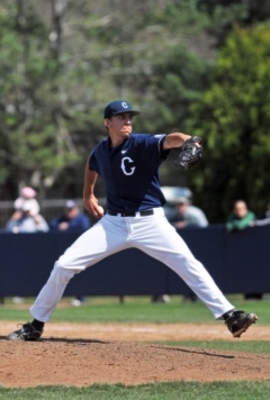
MLB Draft Prospect Scouting Report: Matt Barnes


Team: UConn Huskies


Position: Right Handed Pitcher

Height: 6’4”

Weight: 203lbs

One of the more talked about arms in the upcoming MLB Draft, Matt Barnes has a chance to be one of the first 10 players selected in early June. Barnes is the first amateur player I’ve ever scouted and it is very different to watch college baseball than it is to watch pro, because the players mostly suck, even at the Division 1 level.

Fastball- Barnes throws hard. His 4-seam fastball sits between 92-94mph touching 96 here and there. He also has a 2-seamer that comes in between 89-91mph with noticeable arm-side run. He seemed to like to use that to back-door right handed hitters. He maintains this velocity throughout the game thanks to his lanky, 6’4” frame. While the raw velocity is there the command is not. Barnes was pitching from behind in the count almost incessantly on Friday, as he was unable to throw strike 1. He also refused to challenge hitters inside with the heater, a product of two variables. First, UConn coaches call the pitches, not the battery, so Barnes was at the mercy of the coaches. Second, college pitchers are averse to pitching inside because aluminum bats tend to do more damage with those than wood ones do.

Curveball- A dirty upper 70s curve with 11-7 break, it is Barnes’ best pitch and he knows how to use it. Whether burying it in 2-strike counts, running it away from righties to gets swings and misses, back-dooring it to lefties or even throwing it early in counts to get ahead, Barnes seemed very comfortable using it.

Slider/Cutter- Yuck. In the low 80s, Barnes’ Slitter (hmm…not sure if I like that) is not good. It was so bad that I had trouble recognizing what the hell it was. If you want to pitch at the top of a big league rotation, you need at least 3 viable pitches. The way Barnes develops this (or a changeup, as I’d prefer) is of paramount importance to his future.

Mechanics- Barnes does not repeat his delivery well. I noticed several times his front foot landing in different places in different directions. These inconsistencies are the likely cause of his control issues. Barnes is only 20 and it’s possible he hasn’t fully grown into his 6’4” frame to a point where he has acute control of his extremities. It’s also possible his legs are just weak, tire easily and his delivery gets sloppy as a result. Video and reports on Barnes tend to note he misses up. More often for the start I saw, he was missing away. The arm action is not violent enough to be concerned about, nor is it effortless enough to fawn over.

Whatever team drafts Barnes will have some work to do, but his combination of velocity, pro-ready curveball, size to handle starter workload and bit of projectability won’t let him drop past Milwaukee at #15 overall.

MLB Prospect Scouting Report: Melky Mesa

Team: New York Yankees


Position: Outfield

Height: 6’1”

Weight: 185lbs

From: Dominican Republic (signed in 2003)

Mesa is toolsy, but old. He’s already 24 years old and is only in AA. Let me rephrase that. He’s LISTED at 24 years old. Sometimes these guys from the DR shave a few years off of their real age to get a more lucrative initial deal. Keep those two things in mind as you read.

Offense: The first thing you’ll notice when watching the right handed Mesa hit is his batting stance. It is a straight up theft of Alfonso Soriano’s stance, and Mesa has a similar offensive skill set. Listed at 165lbs just a year ago, Mesa has good power for his still slight frame. He’s hit 50 extra base hits each of the last 2 years (20 Hrs, 20 doubles, 10 triples). He’d have more of them if he hit the ball more often. Mesa’s eye-hand coordination is not good and he struggles mightily to make contact. He had more strikeouts than hits each of the last two years. He’ll never hit for a high average or get on base more than 33% of the time, just because he swings and misses too often, even when pitches are hittable. Mesa has plus speed.

Defense: A fine defender thanks to his speed and above average arm, Mesa can play any of the three outfield positions and play them well.

Overall, Mesa has enough useful tools that he’ll be a useful MLB bench player (think an extremely poor man’s Chris Young) providing late game defensive upgrade and pinch running value.

MLB Prospect Scouting Report: Austin Romine

Team: New York Yankees


Position: Catcher

Height: 6’1”

Weight: 190lbs

From: El Toro High School in Lake Forest, California (and round of 200 draft)

Romine is stuck in a strange limbo in the Yankees system. Behind Jesus Montero in terms of development (and potential) and has the much more talented (but very young/raw) Gary Sanchez breathing down his neck from Single-A. Romine will more than likely become a piece of a trade package for a starting pitcher before mid-July.

Offense: Romine has plus raw power that you won’t see by looking at his numbers because Trenton (AA) is such a difficult environment in which to hit. His swing mechanics are complicated, especially from the waist down, which throw off his timing here and there, which could make him prone to lengthy slumps. He won’t hit for a high average as a result. His plate discipline is lacking. He has below average speed.

Defense: Fan opinion seems to be that Romine is good defensively, likely because he and Montero (who couldn’t catch a cold, or syphilis in a Vietnamese whore house) are always compared to one another. I can say for sure (I’ve now seen Romine at least 5 separate times) that he is not. His receiving skills are poor and his game calling skills are about average. On the other hand, his arm is very strong, though it can be inaccurate at times and his transfer is slow. Romine could probably play left field, but his bat isn’t good enough to profile out there.

Good catchers are hard to come by. Romine will likely be an average everyday catcher for a handful of years before becoming a backup with some pop (think John Buck). All this will likely take place with an organization other than the Yankees.

Friday, April 23, 2010

Scouting Trip #3: Pawtucket Red Sox at Lehigh Valley IronPigs

Wednesday night gave me a chance to look at two very talented and enigmatic pitchers: Red Sox righty Daisuke Matsuzaka and Phillies lefty Joe Savery. Both pitchers have struggled to throw strikes over the past two seasons, and many have soured on the once promising futures of each of them. Here is what I saw Wednesday night.

Joe Savery

Savery was the Phillies' first round pick back in 2007, selected out of Rice 19th overall. A star two-way player for the Owls, Savery was expected to rise through the Philadelphia farm system quickly. That hasn't happened. Savery is a shell of what he was coming out of college.

While he used to consistently pitch in the low 90s with his fastball, Savery's velocity is gone. He was in the high eighties early in the start, hitting between 86 and 89 in a first inning full of nothing but fastballs. I was encouraged by this because Savery's fastball was at 84mph when I saw him pitch last year. However, as his start went along, Savery lost velocity. His fastball would drop to as low as 82mph. A noticeable difference could be seen when he pitched from the stretch, and his average fastball velocity dropped every inning he pitched. Another interesting thing I noticed was this: Savery's arm is VISIBLY SLOW. The only way I can compare it to is the release speed of a QB. Go watch highlights of Byron Leftwich and Dan Marino. Joe Savery's speed of release is like leftwich's. His arm does not have that lightning fast snap and release that most pitchers have. This lack of deception allows hitters to pick the ball up before it leaves Savery's hand.

So why has this occured? Savery had shoulder problems in college which may contribute to his dead-looking arm. His legs may be heavy and out of shape, which lead to to significant velocity drop when he is pitching from the stretch and the importance of leg drive is amplified.

Savery has two secondary pitches; a slider and changeup. He shows a wide range of velocity for both of these pitches as well. The slider sits between 79mph and 75mph and the change between 76mph and 71mph. Neither is particularly infatuating,and Savery generated 0 (Zero) swings and misses them during this outing. He also has trouble throwing strikes.

You may say, "Eric, this range of velocity is abnormally wide and fishy. What if you're an idiot and couldn't recognize a different type of pitch?" If that is true, and Savery was throwing some sort of 4th pitch I could not recognize, then isn't it sad that the movement on this pitch is so poor that I couldn't differentiate it from his fastball?

Savery's delivery and secondary stuff are not deceptive or effective enough for him to even profile as a lefty specialist. He obviously has issues that need to be worked out, but the issues themselves are not too obvious. We can only theorize what they are. I say shoulder problems and poor lower half conditioning.

Due to the NFL Draft (which is keeping me occupied) I'm a little behind on writing these. I'll post my report on Dice-K later in the day.

Monday, April 19, 2010

Scouting Trip #2: New Britan Rock Cats at Harrisburg Senators


Metro Bank Park in Harrisburg, PA is home to the Harrisburg Senators. A regular to the ballpark mentioned to a friend of mine that they usually have about 1,000 people at the stadium for any home game. On Friday night, they had almost 8,000. The stadium was ill prepared and they were running out of food, napkins and electricity (stadium suffered a power surge just before first pitch and totally blacked out). Why? Stephen Strasburg was pitching. I was there.

While my pilgrimage to Pennsylvania's capitol city was so tumultuous and eventful that it would make Odysseus blush, I'm just going to give my report on the much talked about right-hander.

Stephen Strasburg

Strasburg's fastball is great. Hitters who offered at the pitch either swung and missed or popped up. The lack of a radar gun at the stadium (seriously, people its 2010, get a radar gun) limits my ability to ascertain a few things. For starters, I can only rely on what was published to know his velocity. Scouts in the newspapers said his fastball was mostly at 98mph. With the naked eye it looked like he was adding and subtracting from it at times. My seats were not condusive of noticing things like armside run.

His Curveball is his best pitch right now. Sitting in the mid eighties, it breaks down and away from right handed hitters. He throws it for strikes and can bury it in two strike counts to get swings and misses.

The changeup is a work in progess. It since in the high eighties and low nineties and it seems like he overthrows it sometimes. When he overthrows it it lacks a pronounced fade/drop towards the end of its flight. It flashed once or twice as a truly plus pitch.

Due to rain, Strasburg only threw 2.1 innings and so I did not get to see other nuances of his game. How well does he hold runners? Does he throw strikes from the stretch? How does he deal with adversity? How often does he shake off the catcher? These are all tings I want to get to know about Stephen Strasburg. I will try to go out and see him again soon.

For now, he reminds me of a right handed Randy Johnson. Dominant fastball and a dominant and powerful breaking ball (though, The Unit had a low 90s Slider, not a curve). If the changeup develops (which is, along with financial interests, the main reason he is down in AA) then we are looking at a dominance on the Pedro Martinez level.

Sunday, April 11, 2010

Scouting Trip #1: Portland SeaDogs (BOS AA) at Reading Phillies (PHI AA)

A beautiful Saturday afternoon was beginning to waste away and my friends and I were chomping at the bit to go out and do something different. Previous plans to go see a night of amateur boxing in Philly fell through so we scrambled for some entertainment. We decided to head out to Reading to see the R-Phils play the SeaDogs. As I can never pass up a chance to sharpen baseball observation skills, I brought along my notebook. Here's what I saw:

Reading Phillies

Pitcher(s)

Mike Cisco- Cisco (that thong tha thong thong thong) is a small righty, just 5-11, 190lbs. The literature I checked out on him beforehand said his fastball would sit in the lower 90s and possibly touch 94mph. This assessment was optimistic, however, as he was mostly in the high 80s and peaked at 90 just a few times. He had difficulty throwing it for strikes during the first few innings on this night, and fell behind in the count several times. It certainly was not impressive enough to be an effective major league pitch, unless Cisco can locate it better. His changeup (low 80s) was fantastic, especially early on in the game. He garnered 4 swings and misses with it in the first inning alone, including 3 straight during the at-bat of touted Red Sox 1B prospect Lars Anderson. The first time he threw it I actually had to think twice about whether or not it was a breaking ball because it had so much fade/sink. Cisco's change got plenty of swings and misses from lefties, while right handed hitters often made poor contact. He mixed in a curve (which he actually threw for strikes a few times) and a cutter (weak slider maybe?). Neither was impressive.

Cisco was better earlier in the start, when most of the outs he acquired were via grounders. Balls started to take flight towards the middle of his start when the lineup turned over. He worked himself out of a few jams.

I think Cisco could add velocity if he pitched out of the bullpen. He needs to find a way to strike more people out. An improved fastball (by adding velocity or improving command) combined with his plus changeup would make him a viable middle relief candidate in the future. The changeup would allow him to keep lefties off balance and the two breaking balls would help against righties.

Cisco's final line: 6ip, 5 hits, 1 walk, 2Ks, 1 earned run

Hitters

Tyson Gillies (CF)- Gillies came over in the offseason from Seattle as part of the highly controversial Cliff Lee trade. He is a lean 6-2 190lbs. He has hearing aids in both ears which may be a blessing in disguise if he ends up playing for the Phillies one day, since he can simply remove them when he has a bad game. The first thing I noticed about Gillies is that he runs EVERYWHERE. I would too if I could run as fast as he can because he can freaking fly. He runs from the dugout to the outfield and back in again at 75% speed at the start and finish of every inning. He has lots of energy and hustle which will play well if Philly.

At the plate, Gillies is a slap hitter (think Luis Castillo or Chone Figgins) with no power. He failed to hit a ball hard during the game, his two hits being a bloop single that he barely squirted past the second baseman and a sly drag bunt. His On Base Percentage numbers from the past two season are very impressive (both around .430) which means he most likely has a terrific feel for the strike zone. This selectivity combined with his speed can make Gillies a serious weapon at the top of the lineup. However, neither of the times Gillies was on base presented him with a chance to run, so I did not get to see if he had base stealing instincts/skills. He was also not forced to make any defensive plays that I could scrutinize (never had to throw anyone out or chase down a ball in the gap), although he does have the same sort of "hop" that Alfonso Soriano has when he catches a routine fly ball. Youtube it to see what I mean.

The biggest caveat with Gillies comes from his lack of power. At higher levels (AAA and MLB) pitchers will know he has no power and simply challenge him with pitches in the strike zone. He may be forced to put ball in play on more at bats then he would like and his walk rate will drop. About 70% of balls in play are recorded for outs. His OB% will drop and his speed will be kept off the bases.

I want to scout Gillies again and get a look at his arm, his defense, base-running and pitches per at bat tendencies.

Domonic Brown (OF)- Brown is universally regarded as the Phillies top prospect. I got to see why for myself. 6-5 and lean, Brown has the frame to add muscle without losing his baseball skills. He's a tremendous athlete and had a scholarship offer to Miami (Domonic Brown.....the U) to play baseball and football.

Each of Brown's at-bats (he went 1 for 4) ended with him drilling the ball, most of the time down the middle of the field. His final plate appearance culminated with a blast to dead center that was caught at the warning track. His has great bat speed (something I'm just starting to be able to discern) which he showed on this near-homer as he allowed the ball to travel very deep into the hitting zone. Brown seems to recognize pitches well.

Like Gillies, I he wasn't forced to make any plays in the field or on the bases. I need to see him more to get a better idea of what he can do.

Several other interesting players participated in this game, but I will not get into what I noticed with those guys right now because it is getting pretty late and I have an 8 o'clock class tomorrow (Chemistry). Next Friday we are heading out to Harrisburg to check out Stephen Strasburg, Drew Storen and more, Be sure to check back then for another installment. of scouting and all week long for other random things.