Wednesday, January 26, 2011

Sex on the Bandwagon: Theorizing The Popularity of the Pittsburgh Steelers


 I know, I know, just don't look at the middle one.
“Pittsburgh Steelers fans travel well”

You probably hear it several times every football season.  It speaks to the abnormally large number of Steelers fans that can be found at every NFL road game.  I’ve been to two games in which the Steelers were the road team and in both cases I was blown away by how many fans they had in attendance.  Is it possible that it just SEEMS like there are more of them because they are also abnormally annoying?  That’s unlikely.  I wanted to think about the reasons the Steelers have been able to overcome their rather pedestrian market size (Pittsburgh is 22nd in the country) to have the NFL’s most rabid fan base.  These are my thoughts.


After World War II, American soldiers came home to their pining wives.  They hadn’t seen each other in quite some time and, naturally, both parties craved some sweet, sweet love making.  There was a lot of banging going on.  This resulted in what we refer to as “The Baby Boom.”  It was a major spike in our country’s birth rate.  The Baby Boom lasted from around 1946 to 1957 when women started faking headaches and “feeling tired” again.  Population rates started to dip back down to normal.  

Graph is purposefully huge

Flash forward, Lost style, to 1970.  The Baby Boomers are now between 13 and 24 years old.  By the end of the decade, they will be between 23 and 34 years old.  Prime time for them to start families of their own.  Corresponding with this exponential growth in population are several factors.

 
First off, color TVs became common in most American homes.  Cable subscriptions in America tripled between 1970 and 1979.  No longer were people forced to squint at Jackie Gleason, they could now simply enjoy how deliciously offensive Archie Bunker was (when you think about it, racially charged jokes become more diverse in color when you can differentiate between races more readily I am going to hell).  Yes, TV was maturing, but it was nowhere near the monster we have today.  The channel selection was minimal, only a few to go around, and so the big time networks dominated.


Secondly, the NFL became the NFL.  In 1970 the NFL and AFL merged, separated the league into two conferences with CBS broadcasting the NFC games and NBC broadcasting the AFC games.  ABC broadcasted Monday Night Football for the first time in…..yup, 1970.  So football is on TV in its modern format and it is in color.  Production value on TV is better and programs are more stimulating to watch.  We took a huge step forward in the quest to make watching games at home more fun than watching them in person (we are there now, but that’s an entirely different post).  

 Look at that little monkey broadcast

So far we have this run on sentence: This monstrous generation is now in a key age range (either highly impressionable teenagers or young adults getting their first taste of disposable income) with access to color TVs and the NFL looks AWESOME in color, way better than in black and white, and it is being shoved down their throats on two of their only handful of channels every Sunday.  

 Jack Lambert

You already know where this is going.  The Steelers were the dynasty of the 1970s.  How many things come to mind when I say, “70s Steelers”?  A dozen hall of fame names, one of the best nicknames in all of sports, 4 Super Bowl Championships, 7 division titles and other stuff I’ve left out.  The Steelers were great and they were on TV a lot.  The Baby Boomer generation fell in love with the Steelers.  

 This commercial would only work with someone the country loved.  Do you think Nixon could have sold Coke like Mean Joe?  Fuck no.

They had kids (those kids are now in their forties) and they had kids (today’s teenagers).  They’re likely to be Steelers fans as well.  It is perfectly natural for people to be attracted to winning teams, it happens all the time.  I've seen it first hand here in Philly as the city beams over the Phillies.  However, sports history has never seen a bandwagon born on this great a scale and it never will again.  The dawn of free agency and the salary cap make it nearly impossible for a team to have as dominant a 10 year run as the Steelers did, and a team that belongs to an entire generation is a freak thing of the past.  
 
So during the next week and a half leading up to the Super Bowl when you inevitably hear some say something complementary about the Steelers fan base, you can feel free to explain to that person why it is so: War, Sex and Television

Sunday, January 16, 2011

NFL Draft Prospect Scouting Report: Da'Quan Bowers

Da’Quan Bowers


Position: Defensive End

School: Clemson

Height: 6’4”

Weight: 280lbs


Bowers sits atop many an “expert” draft board. He has the prototypical size, speed and athletic ability you look for in a dominant pass rusher. I don’t have to tell you how important it is to put pressure on the QB in today’s NFL. You know stud D-ends come at a premium, so it wouldn’t surprise me if Bowers came off the board in the top 5. In fact, he may go #1. Last time the Carolina Panthers were this bad, they began their rebuilding process by selecting a defensive end with similar physical characteristics from a local school (Julius Peppers), and two years later they were in the Super Bowl. Caveat emptor, Carolina.

Pass Rushing Ability: Bowers has great straight line speed, especially for a 280lb guy, but he has no moves. One can watch the entire video below and he does nothing more than bull rush the opposing blockers to no avail. If he’s not strong enough to run through Olinemen in college, he won’t do it in the NFL. He doesn’t even try to blow by anyone up field. Florida State felt comfortable blocking him 1 on 1 with a Tight End several times and he never got off the block. His sack in this game came on an O-line miscommunication when Clemson showed a rare 3 down lineman look and brought a strong side overload blitz. As far as being a 1 on 1 pass rushing 4-3 end, I don’t think Bowers can do it at the next level unless he receives some serious coaching. I’ll get into what I think he can succeed at later.

Against the Run: Bowers is strong enough that lineman don’t blow him off the line but he’s not strong enough to shed blocks by throwing blockers to the side. On toss sweeps to his side, Bowers does a good job of moving laterally, forcing the runningback to continue running toward the sideline and preventing him from getting actual yardage while other defenders swarm to the ball. His speed makes him good in backside pursuit but in order to pursue from the back side Bowers would need to break contain which makes the defense susceptible to end-arounds and bootlegs. I don’t see Bowers as a liability against the run, but I don’t see him as much of an asset, either.

Other: Has missed some time due to injury but none due to off the field stupidity. Clemson used him at both ends of the line and even kicked him inside to defensive tackle in obvious passing situations. I think Bowers could excel in the NFL as a strong side 3-4 outside linebacker. He can use his quick first step and speed to get up-field and force the offensive tackle to follow him there and then use his strength to rip back underneath the now off balance lineman. He’s good enough against the run to hold up there as well. Of course, we’ll have to wait for the combine or pro day to see if Bowers is comfortable in a two point stance and whether or not he can back pedal and cover tight ends. As a Panthers fan, I’d be very upset if they took Bowers #1. I’m not buying it, and while I’m in the minority, I’m comfortable with my assessment.

Tuesday, January 11, 2011

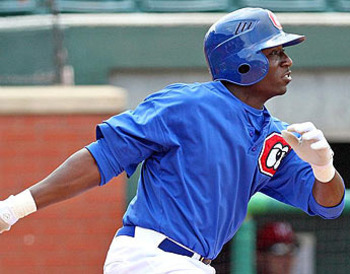
Arizona Fall League Scouting Report: Trayvon Robinson

Trayvon Robinson OF (Los Angeles Dodgers)


Age: 23

Bats: Switch

Height: 5’10”

Weight: 175lbs

From: Crenshaw High School (10th round of 2005 draft)

Sometimes teams will draft high schoolers with a bevy of physical tools but little in the way of baseball skill. These are your typical boom or bust type picks, and lots of times these guys take more time to reach the majors than your polished college players (think about how polished Rick Porcello was coming out of high school vs how raw Phillipe Aumont still is). Trayvon Robinson is one of those raw, physically gifted athletes that needed time. Actually, Robinson didn’t even start switch hitting until after he was drafted. Grab a bat and swing it from your weak side. Try not to look like an idiot. Think about how goofy you look and now imagine trying to hit pro pitching like that.

Robinson spent 2006-2008 mired in prospect limbo waiting to yield results. In 2009 he finally broke out hitting .306 with a .375 OBP and .500 Slg% at Hi A before moving to AA. He hit more HRs that year than he did in his previous four years combined. He also stole 43 bases. The Dodgers already have

Offense:

Robsinson hits well from both sides of the plate but you can tell in BP that he has more power from the right side. His swing mechanics are fine. What he sometimes has a problem with are his feet and what he does pre-swing. In the batting practice video below you can see he is well out in front of the first few pitches before he starts to adjust. His front foot is hanging in the air far too long and throwing off the timing of his swing. That’s too many moving parts to control at once which makes it difficult to have a fundamentally sound swing. In the second video, you can see his front foot is down much earlier. This doesn’t hinder his hip rotation, which is where a lot of swing power comes from. The Dodgers have worked with his pre-swing motions.

Robinson’s walk rate has also vastly improved. Instead of 3 walks every 30 plate appearances, Robinson is walking 3 times every 20 Pas. That may not seem like much but over the course of a season it is the difference between a .350OBP and a .400 OBP, which he posted in 2010. He was a little too patient when I saw him in Arizona, striking out looking 3 times in the two games I saw him play.

Combine those on base skills with Robinson’s elite speed (40 steals each of the last 3 years) and you’ve got a potential leadoff guy with some power.


Defense:

Robinson has the physical tools to play in CF; great speed and an average arm. However, he doesn’t always take great routes to ball and the Dodgers already have a CF in place. He’d be above average in LF and I’d expect him to play their regularly for the Dodgers by late July.


Tuesday, January 4, 2011

NFL Draft Prospect Scouting Report: Andrew Luck

Andrew Luck


Position: QB

School: Stanford

Height: 6’4”

Weight: 235lbs

Historically, I’ve had trouble evaluating QBs. To have trouble assessing those who play the single most important position in all of sports does not bode well for a future in an NFL front office (which is why I’ve transitioned toward baseball). However, the Carolina Panthers’ collective futility and 1st overall pick in the upcoming draft has me revisiting the process of scouting college signal callers because after watching Jimmy Clausen for 5 minutes you know they really need one.

This brings us to Luck, who is first on lots of expert draft boards. I sat down with a couple people to watch him play in the Orange Bowl and make a judgment call on his abilities.

In the Huddle:

Stanford has an extensive playbook. Its depth is such that it necessitates that Luck wear a wrist band with a list of plays on it. In fact, the playbook is so deep that Stanford’s Center has to wear a wristband as well because not all of the plays will fit on just one wristband. Plenty of NFL QBs lean on a similar crutch, and it’s not like they have a full load of classes and extracurriculars on their plate. Luck should have no problem communicating plays to teammates on Sundays.

Pre Snap:

Stanford uses a lot of pre snap movement, often shifting multiple players at a time. I noticed most of the time Stanford ran the ball post shift, so it is unclear if Luck is using this movement to identify coverages or if it is just a cog to confuse the defense. Either way, the foundation for using motion to identify coverage, a very valuable asset for an NFL QB, is in place.

Reading Coverages:

Virginia Tech rarely played straight man to man. They were mostly in zone coverage or man to man on the WRs on the outside with two deep safeties and the linebackers in intermediate zones. Luck held onto the ball longer than I’d like to see, especially early in the game. As the game went on he was getting rid of it more quickly. Either he was having trouble making his reads or his WRs weren’t getting open. Whatever the case, it was encouraging to see Luck adjust and improve as the game went on. It’s also possible he was nervous. 21 year olds get nervous when they have to do something in front of a few million people.

Pocket Presence:

Luck moves well in the pocket, and is very athletic and mobile when he needs to be. He wasn’t presented with heavy blitzes so I can’t determine how he would respond to them.

Throwing the Ball:

Luck’s mechanics were poor early in the game. His stationary mechanics were funky and he was jumping when he threw the ball on rollouts. Later in the game he improved dramatically. He has a good arm, not elite but more than good enough for the NFL. He is accurate in the pocket but tends to underthrow guys a little bit when he’s on the run. He showed good touch on short passes. Once he decides to throw the ball, it is out of his hands quickly.

Intangibles:

Everything seems in check. He seems to have a good head on his shoulders. I highly doubt he’ll get into fights at strip clubs or murder more than one drifter during his career.

Advanced Metrics:

The Lewin Career Forecast (a regression analysis that values completion% and games started in college as the most influential factors in determining a QB’s NFL success) may not be optimistic about Luck. Luck only has 26 or 27 games started for his career and a poor completion% last year (56%) drags his career numbers down. If Luck is a bust, it’s a notch in the belt of this metric. The specifics (who compares to Luck in this aspect and how they turned out) I’ll know closer to the draft.


How sexy is this?


Prediction:

He’ll go #1 if he comes out. He reminds me of Aaron Rodgers, built thicker and stronger and more durable.

Thursday, December 30, 2010

Arizona Fall League Scouting Report: Eric Hosmer

Eric Hosmer 1B (Kansas City Royals)


Age: 21

Bats: Left

Height: 6’4”

Weight: 215lbs

From: American Heritage High School, Plantation, Florida (#3 Overall pick in 2008)

Hosmer’s first pro season (2009) was extremely disappointing as he posted a paltry .707 OPS (major league average is .730) between low and high A ball. His struggles can be attributed to an astigmatism, which he developed during the offseason prior to the 2008 campaign and was diagnosed with prior to the season. Combined with his poor eye sight which was eventually corrected by Lasik eye surgery, Hosmer fractured a knuckle on his right hand which impeded his ability to grip the bat. When you can’t see the ball you’re supposed to hit or grip the bat you’re supposed to hit it with, you are going to struggle. The results he yielded in 2009 caused him to fall to #5 in Baseball America’s Prospect Handbook, down from #2 the previous year.

The following season, Hosmer had a fantastic .977 OPS while hitting 20 HRs, 7 of those HRs coming in an infamously difficult home park at Single A Wilmington. He reached AA ball at age 20 and completely reestablished his astronomical value as one of baseball’s better prospects. He’s turned everything around and has all star potential.

Offense:

Hosmer has a smooth left handed swing. He combines fine bat speed with good balance and generates plus raw power. He takes the ball the other way comfortably. More impressive for me are his low strikeout totals. Hosmer struck out 66 times in 520 at-bats in 2010 and walked 59 times. That’s a rather impressive ratio for someone to boast for their 20 year old season.

The one problem Hosmer has is a tendency to get his front foot down late (Ryan Howard has the same problem from time to time) which throws his swing off and causes him to get pull happy.

Hosmer is a below average runner and won’t help on the bases.


Defense:

Hosmer has an above average throwing arm that would play in the outfield which would be beneficial to the Royals because of the glut of 1B/DH types they have coming up through the minors, but his slow feet would limit his range in an outfield corner and he’d end up as a liability. He has soft hands and is enough of an athlete to be above average at first base.


As far as ceilings go, Hosmer may be the best 1B prospect left in the minors (though Brandon Belt is much closer to the majors) and is one of the crown jewels of the Royals’ stellar farm system.


Above: A couple looks at the swing
Below: A really great at-bat

Monday, December 20, 2010

Arizona Fall League Scouting Report: Jeremy Jeffress


Jeremy Jeffress (Kansas City Royals)


Age: 23

Height: 6’1”

Weight: 185LBS

From: South Boston, VA (1st rounder in 2006 straight from High School)

Part of the recent Zack Greinke trade, Jeffress had one of the more electric arms I got a chance to see at the Arizona Fall League. We’ll get into that in a minute, but upfront there’s one very important piece of information you should know about Jeffress. He’s one toke away from a lifetime ban from baseball. Jeffress has already been suspended twice for violating baseball’s substance abuse policy and a third time means he’ll get the boot. I don’t have a problem with pot use as long as it doesn’t alter work habits or on field performance, and in Jeffress’ case it just might.

Like a lot of the pitchers in Arizona, Jeffress had primarily been a starter during his pro career (unitl this past season) but projects as a bullpen arm. The Royals will almost certainly insert him in the bullpen immediately, in part to free him from the more strict nature of the minor league drug testing policies. If the Royals decide to trade Joakim Soria, Jeffress will be ticketed for high leverage inning (the few that exist in KC) work right off the bat.

Stuff:

Jeffress’ fastball is devastating. He sat at 95-97mph and touched 99 once when I saw him in person in mid October, and then hit 101mph on TV during the Rising Stars game. It’s very straight, almost no tail, but the raw velocity behind it more than compensates.

Sure, the fastball is good but the secondary stuff is lacking. I had read that his curveball was flashy and inconsistent but I didn’t even see a glimpse of a swing and miss breaking ball in any of his outings in Zona. When he did throw it, it was blunt and hittable in the upper 70s. His changeup sits in the mid to high 80s. He can throw it for strikes, but his arm speed is noticeably slower than it is when he throws the heater. The dominant fastball and lack of viable secondary offerings already points to the bullpen.

Mechanics:

Throws from a three quarters arm angle and has fairly easy arm action for someone who throws so hard. He does not repeat his delivery well. You can clearly see this in the video below when he drops his arm angle significantly on his final warm up offering. This inability to repeat the same throwing motion leads to control problems and is likely the cause of his curveball’s inconsistency as well as his problems with command.

Stats:

He strikes out a ton of batters, and has had problems with walks (sounds like a reliever to me). His walk totals dropped significantly last season (from 8 per 9 innings in 2009 to 3 per 9 innings in 2010) but the sample of innings from 2010 is too small (due to the suspension) to say his control issues are solved.

Sunday, December 19, 2010

NFL Draft Pospect Scouting Report: Jerrel Jernigan

Jerrel Jernigan


Position: WR

School: Troy

Height: 5’9”

Weight: 190lbs

Offensive trends in the NFL are ever changing. We now see more shotgun formations and multiple WR sets than ever before. As such, teams are finding value in WRs that change direction quickly, run good routes, and get yards after the catch. Guys like this (Wes Welker, Davone Bess) turn a high percentage, short pass into gains of 7-15 yards and some even bust them for big plays. This is the kind of player I was hoping to see when I turned on the New Orleans bowl to watch Troy WR Jerrel Jernigan. The things I read in preparation for scouting Jernigan had me thinking that he might just be evolution’s next logical step in wide receiverdom.

Speed: He’s got plenty. He’s not DeSean Jackson or anything like that, but he’s certainly faster than your average receiver. I timed him at 4.46 from the 40 to the goal line in full pads on a QB Power Right run out of the Wildcat. It’s good to know that his stature doesn’t hinder his speed when he’s fully dressed. Lots of these WRS that run good 40 times at the combine can’t carry pads and a helmet and maintain that speed. Jernigan can.

Route Running: This is a difficult thing to scout from watching TV because often times WRs will run out of frame. From what I DID see, his routes aren’t sharp all the time. He’s been able to rely on his physical gifts to get open thus far. He won’t be able to in the NFL. Route running can always be coached, though, as long as Jernigan is receptive to it. So while he’s raw right now, he has tremendous potential in this area.

Hands: He catches the ball with his hands, which sounds like the most obvious thing in the world, but lots of receivers use their bodies to catch the ball, which lead to drops. I counted two occurrences on Saturday when Jernigan looked to turn upfield before he had the catch well secured.

Other: Not a good blocker. Operates very well with the ball in space a la Donte Stallworth. Didn’t have a chance to see him go up for any jump balls. Jernigan average 15 yards per catch his junior year and only 9 yards per catch during his senior campaign. While this would normally be cause for concern, it’s likely due to the absence of QB Levi Brown who graduated after last season and is now in the NFL. May have trouble with press coverage.

Prediction: 2nd maybe 3rd round. Not enough skills to offset his physical limitations and be a #1 WR but should excel in the slot guy and as a weapon on returns.